How to Make a Drama: The Modern Production Path, Script to Screen
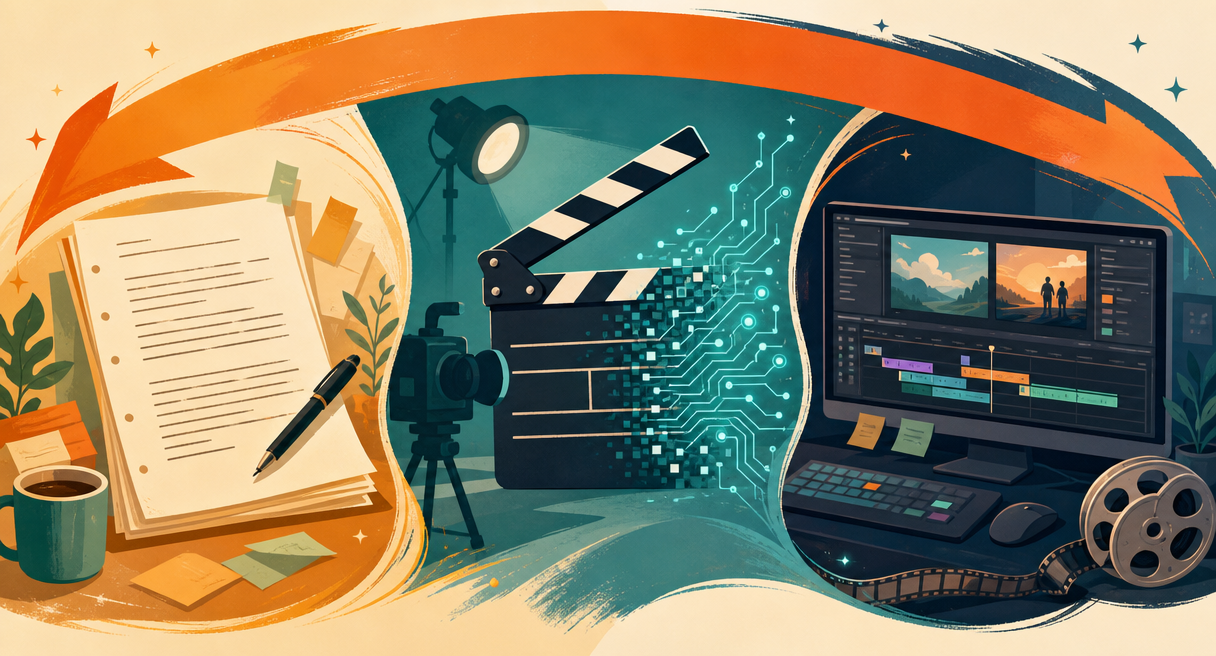
Making a drama in the short-form era is a pipeline with fixed stages and one new variable: how much of the execution the machines carry. The stages themselves have not moved. A drama still begins as a premise pressed into a script, becomes footage through either a physical shoot or an AI-assisted production line, and finishes in post shaped for the vertical screen it will live on. What has changed is the cost of each stage, and therefore who gets to run the pipeline at all. This guide walks the path in order, keeps most of it craft-first, and closes with finished AI-era dramas worth reverse-engineering.
Start with the script: premise, arc, and episodes
The script stage owes you three deliverables: a premise sentence holding the conflict, a character arc with a visible curve, and an episode structure sized for vertical viewing. Writing stops being speculative the moment all three exist on paper.
Begin with the premise sentence, the tool every working screenwriter keeps closest: who wants what, what stands in the way, and what failure costs. In this genre band the load-tested formulas are explicit, and they are starting geometry rather than creative limits: fantasy romance built on impossible attraction, the reversal arc that takes a heroine from humiliation to command, and suspense structures that ration their reveals. A formula leaves the writer's energy for the part formula cannot supply, which is execution.
Give the protagonist a curve, not a description. Archetypes with proven audience pull include the strong heroine rebuilding after a fall and the obsessive lead whose devotion is both flaw and engine; the arc is the measurable distance between what the character wants in episode one and what they have learned by the finale.
Size the episodes honestly. Vertical drama episodes generally run one to three minutes, with two to three the typical case, and each one must close on a hook, because the viewer's thumb is one swipe from leaving. Full series in this format stretch from roughly forty episodes past eighty, and the count should be fixed at the script stage, since every later stage is priced by it. The concrete deliverable here is a complete script for episode one: scene by scene, line by line, hook at the end.
Production: how modern dramas actually get shot
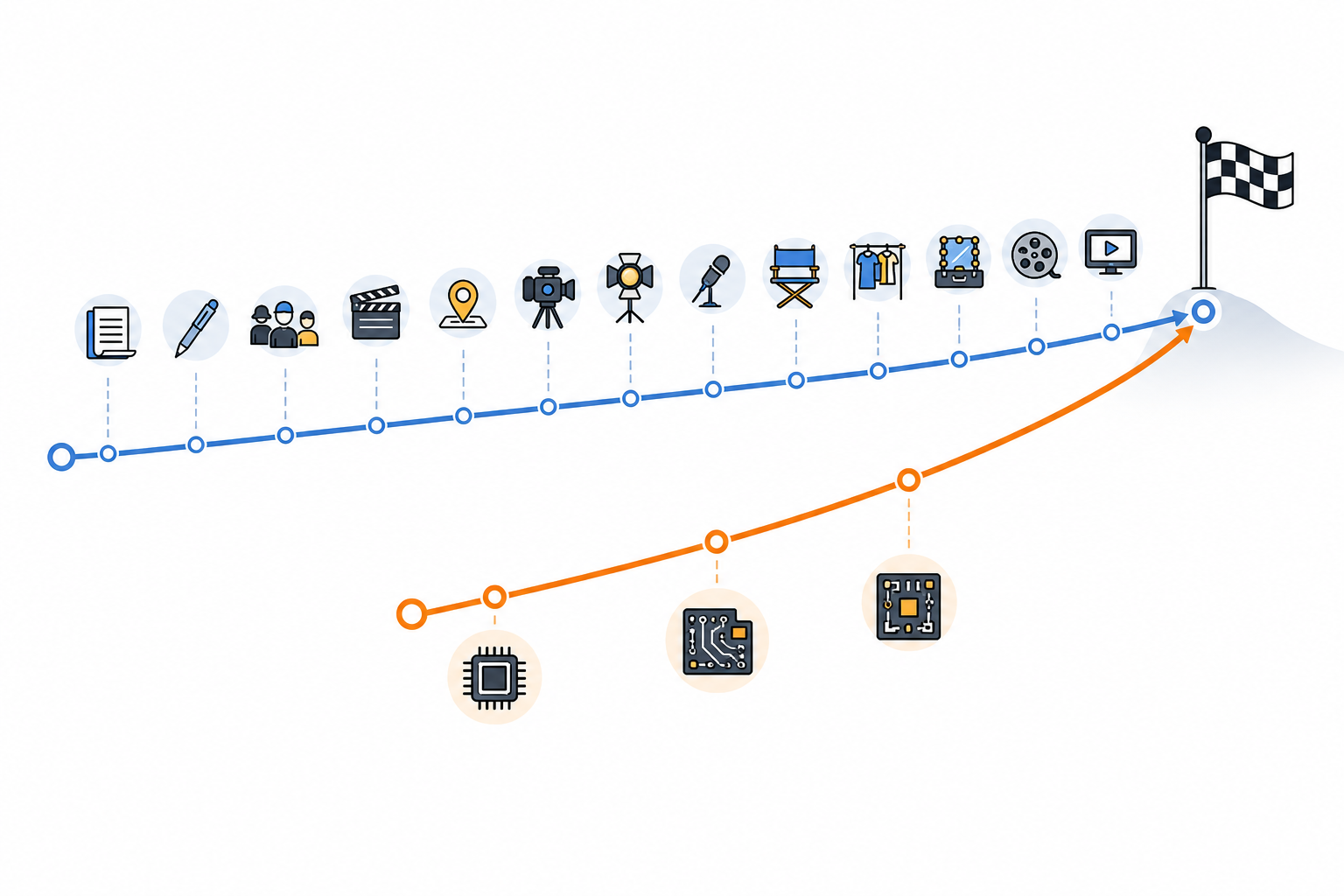
Production follows one of two cost structures. A traditional shoot buys control with crew, equipment, and calendar time counted in months; an AI-assisted production line trades some of that control for speed, with machine agents executing across stages while human creators hold the judgments that define the work.
The traditional path is the one most production guides describe: locations, cast, lighting packages, a crew schedule, and an edit that begins weeks after wrap. Its cost structure is linear, and honestly so: every additional minute of finished drama buys a visible stack of crew days, gear rentals, and calendar risk. For a team with funding and a specific visual target, it remains the straightforward choice.
The AI-assisted path reorganizes the same stages around machine execution. In current production lines, AI agents work through the pipeline: drafting support, character and scene generation, voice, and visual assembly all carry machine acceleration, while story architecture, characterization, camera grammar, and aesthetic judgment remain the human team's territory, a division the industry describes openly as collaboration. The calendar compresses accordingly. Internal estimates from DRAMAGO's own operation clock a standard series at ten to fifteen days per round and the flagship tier at roughly a month; a traditional schedule for comparable output is measured in seasons of planning, not weeks.
Both lanes have a minimum viable start worth pricing. On the traditional side the kit is small: one camera or a late-model phone, a tripod, a clip light backed by a window, a lavalier microphone, one controlled location, and a plan to shoot two to three episodes per day. On the AI-assisted side the kit is a stack: the finished episode-one script, a locked character reference so faces stay consistent across scenes, scene-by-scene generation of voice and picture, and a review pass over each finished episode before the next one begins. Neither list is exotic, and that is the entry-level story in miniature: the expensive part is the discipline, not the equipment.
Neither path is a shortcut around craft. What the machine layer removes is execution cost, not decision load: the script still has to be worth producing, and the judgment calls still belong to someone whose name is on the work. Choose by constraint: control you can afford, or speed you can direct.
Post-production and the vertical format
Post for vertical drama is three adjustments to habits learned on wide screens: recompose for a 9:16 frame, retune subtitle timing for fast dialogue, and lay music to the emotional beat rather than the scene length. The format is a grammar.
The frame comes first. A 9:16 canvas favors faces over landscapes: close and medium shots dominate, wide establishing views are spent sparingly, and lateral camera movement mostly becomes vertical or forward motion. Coverage planned for the vertical frame during the shoot pays for itself here; footage shot wide and cropped loses the edges the story needed.
Subtitles are the second adjustment. Short-form dialogue runs fast, and subtitle timing decides whether it lands: lines appear and clear in rhythm with the delivery, key words are never buried under the next cut, and the text sits inside the safe area of the frame. Viewers experience subtitle timing as pacing, even when they never consciously notice the timing itself.
Sound is the third. Emotional genres in this format lean on a dense score, and the music should change on the story's emotional beats instead of trailing evenly beneath the scene. The finished master then follows the format's shape: episodes of one to three minutes, each cut to its hook, in whatever episode count the script stage fixed.
Where the craft is heading: AI dramas you can watch today
The fastest way to calibrate any stage of this path is to watch finished work from a pipeline that runs it at scale: linear AI live-action dramas rolling out in seasons, and interactive titles stacking branching on top. Reading the credits is optional; reading the results is not.
Finished AI live-action dramas are publicly listed today. A Crown of Venom has run three seasons totaling 62 episodes, and My Mind, His Playground runs 40; both are linear, both are AI live-action, and both demonstrate the production cadence. The interactive side goes further: Sterling Lies carries three full branch lines through 74 episodes, and Blood on the Badge runs 14 branches, timed prompts, and explorable scenes across an 87-episode investigation.
These titles are the reference prints of the modern path. DRAMAGO, the AI-native cinematic entertainment platform behind them, lists each one with its introduction in the drama library, and the practical exercise is to take a flagship series and reverse-engineer it against this guide: where the premise lands, how episodes close, how the machine-executed stages read on screen. The threshold that dropped in the AI era was the cost of producing; the threshold that did not move is the story, and that second threshold is the one every stage of this guide has been aimed at.
Frequently asked questions
How much does it cost to make a short drama?
It scales with the path. A traditional shoot carries crew, gear, and location costs that grow linearly with runtime; AI-assisted production lines cut the execution overhead, with professional interactive series turning around in roughly two weeks to a month per round. Either way, the script costs only attention.
Can one person make a short drama?
One person can carry the script stage completely, and small teams ship vertical drama regularly. Filmed production, traditional or AI-assisted, remains a crew effort at professional quality; the realistic solo path is script first, collaborators second.
Do I need AI tools to make a drama now?
No, and the tools do not make the decisions. AI execution compresses the production calendar, while story structure, characterization, and visual judgment stay human on every serious production line; treat the machine layer as speed you can direct, not taste you can rent.
Where can I watch finished examples?
The titles named in this guide are listed with their introductions in the DRAMAGO drama library, and the platform's catalog page is the public entry point for browsing them.