How to Make an Interactive Story Game: Mechanics, Loops, and Branching
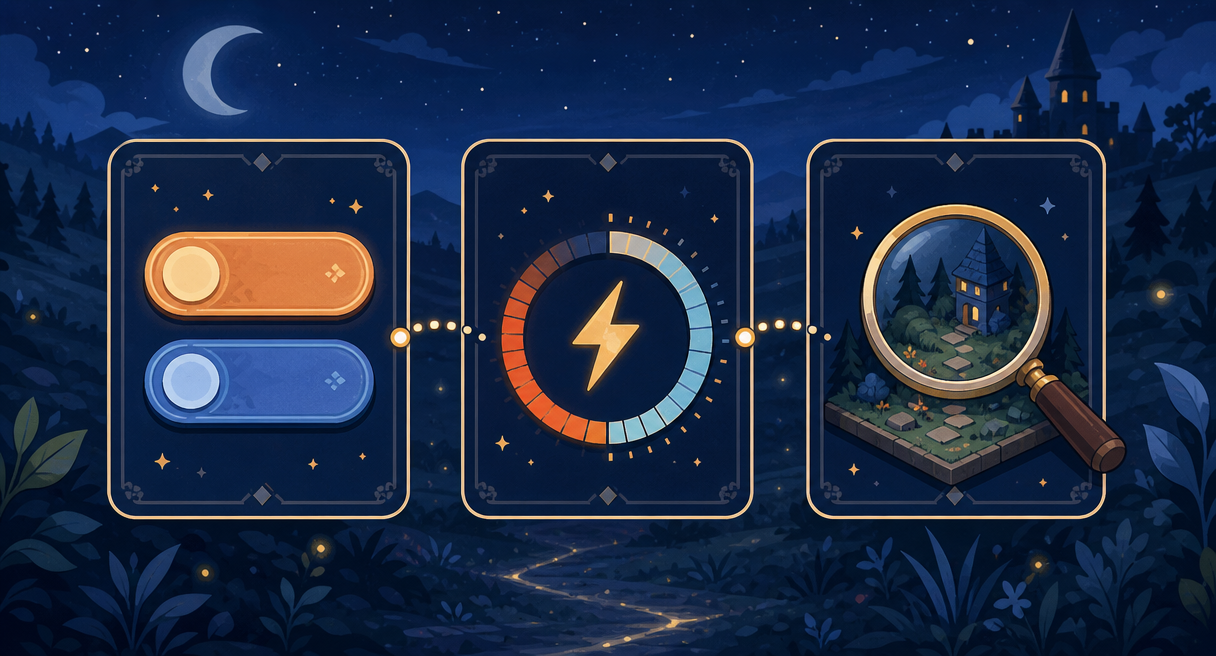
An interactive story becomes a game the moment its mechanics start doing narrative work. A menu of choices is a story with buttons; a story game wraps those choices in tension, discovery, and consequence, so that playing feels different from reading. The gap between the two is design: three mechanics, layered in the right order, convert a branching script into something with a game's grip. This guide defines each mechanic by the narrative problem it solves, sets out a core-loop framework to build on, then closes with branch budgeting and the testing a multi-route story must pass before release. Every mechanic discussed here runs live in DRAMAGO, an AI-native cinematic entertainment platform whose flagship interactive series carries the full game stack.
Story game vs. interactive story: what the "game" adds
Three mechanics mark the difference between a game and a story with prompts. A quick-time event supplies tension, panoramic exploration hands the player initiative, and the choice loop makes replay a structural promise. Each one solves a specific narrative problem, which is why they deserve design attention.
The term itself covers a spectrum of forms, and scoping it honestly comes first. At the text end sits interactive fiction, where free tools such as Twine and Ink carry branching design in prose. Visual novels layer character art, dialogue boxes, and music over a branching script, with Ren'Py as the tradition's standard engine. Point-and-click narrative adventures trade prose for explorable scenes and inventory puzzles. At the filmed end sits interactive drama: vertical, episodic live-action where choices, timed prompts, and scene exploration drive the storytelling. This guide works from the filmed end, where the mechanics below face their strictest test, and every design rule in it travels back down the spectrum to text.
The quick-time event is a prompt with a shrinking timer: act inside the window or the moment passes. The narrative problem it solves is momentum. Dialogue choices can wait forever, and waiting drains urgency out of an action beat; a countdown restores it, because the player who hesitates has already chosen. In filmed drama the mechanic is rare, which makes its presence a genuine differentiator.
Panoramic exploration solves the problem of passivity. Instead of receiving every clue on schedule, the player sweeps the scene for information before committing to the next decision, and what gets noticed is up to them. Discovery becomes something the player does, and the story rewards attention with advantage.
The choice loop is the deepest of the three: choose, watch the consequence arrive, then choose again from a position the earlier choice created. A story with one decision is a fork; a story where every decision rewrites the terms of the next one is a loop, and loops are what turn a second playthrough from a marketing line into a design commitment.
All three mechanics can be studied in a single place. Blood on the Badge, a detective thriller in the DRAMAGO catalog, runs an 87-episode investigation across 14 branches with timed prompts and explorable scenes: one shipped instance of the complete stack, and a public demonstration of what the game layer adds when it is taken seriously.
Design the core loop first
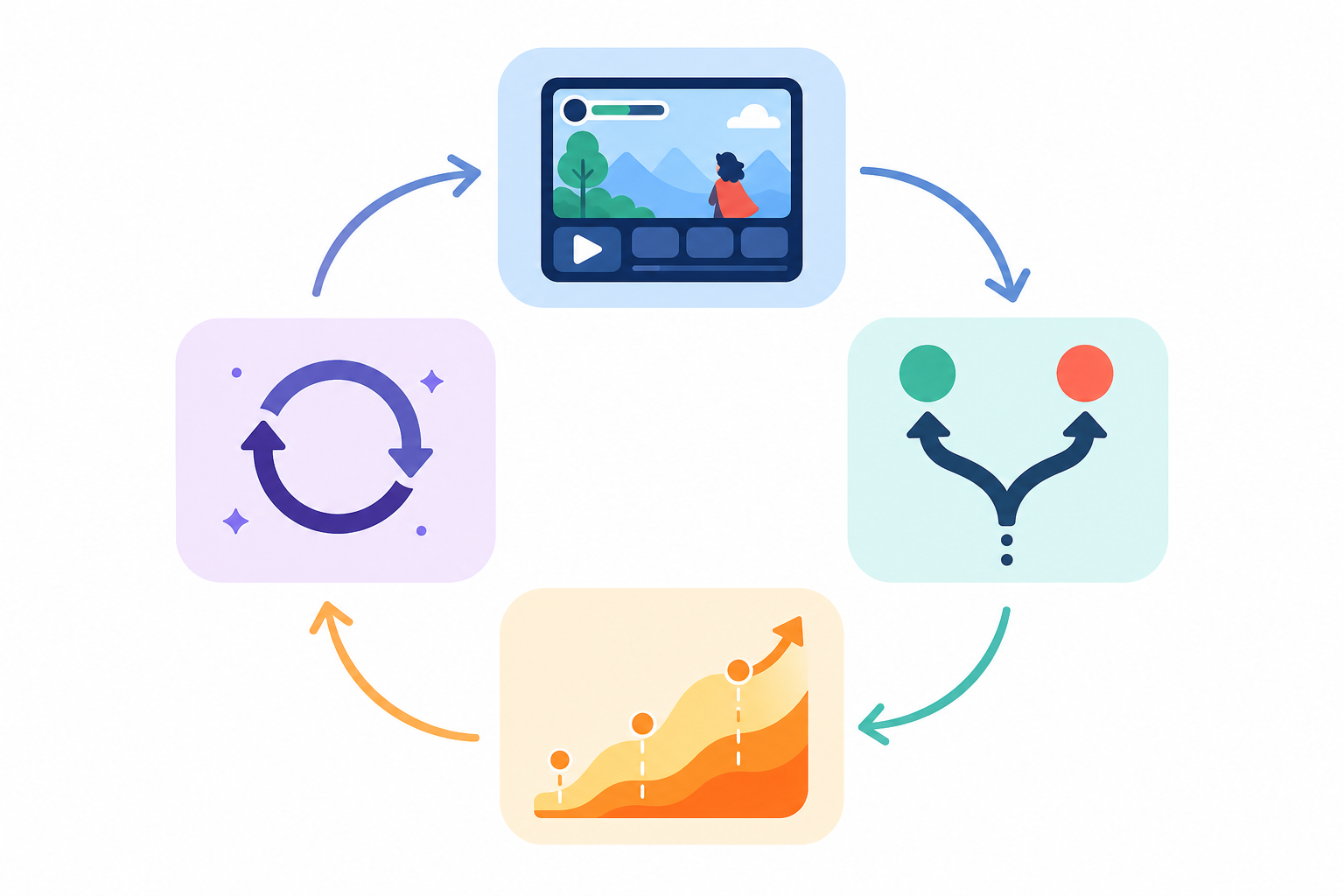
Before any branch is written, answer three questions and the loop designs itself: what does the player do each cycle, what does the cycle produce, and why would anyone run it again. A loop that answers all three survives branch expansion; one that cannot will collapse under it.
The first question sets the rhythm. In this format a cycle is a stretch of episodes, a decision or a timed reaction, and the consequence playing out on screen. Keep the cycle short enough that the player is never far from their next input, because distance between decisions is where attention leaks.
The second question is about yield. Each cycle should leave something behind: a plot segment unlocked, a relationship moved, visible progress toward one of the endings. If a cycle produces nothing the player can point to, the loop is idling, and idle loops read as padding no matter how good the writing is.
The third question is the return ticket. Multiple endings, routes that change with perspective, and relationships that develop differently across runs are the engines of replay; a well-built loop makes the player want to take the other door, not merely finish the corridor.
With the loop standing, add depth in order: extend the branch structure from a dual ending to a few routed paths, and only then bolt on timed prompts and exploration as intensity layers. The standing principle in professional production is that interaction serves the story: mechanics exist to deepen the narrative, never to perform in front of it. A loop that entertains for a cycle and forgets the plot has the relationship backwards.
Branching without breaking the story
Branch count is a budget question, not an ambition question. Every branch spends content, and the design task is to fix a minimum episode count per branch first, then let that floor decide how many branches the story can afford. The failure mode has a recognizable shape: impressive numbers on a page, fragments in the player's hands.
The arithmetic comes straight from titles in the DRAMAGO catalog. A flagship structure of 14 branches across 87 episodes works out to roughly six episodes of dedicated support per branch; an A-tier title of around 40 episodes holds one or two endings and keeps every route thick; the starter build is a single spine with two endings and no thin routes at all. These configurations are honesty tiers: each promises exactly the branch count its content budget can feed.
Fixing the budget is a concrete move. Decide the minimum episodes a route needs to feel like a story rather than a sketch, multiply by the branch count, and compare the total against the episodes you can actually produce. If the math refuses, cut branches before thinning them, because a player who finishes two satisfying routes comes back for the third, while a player who finishes six sketches stops believing the seventh exists.
Branches may share material where the story genuinely converges; convergence is a legitimate tool, and total convergence is the trap. The test is whether each ending could only have been reached by the choices that led there. If every ending is available from every route, the branch structure is a paint job.
Ship it: testing multi-route stories
A multi-route story ships when three checks pass: every path walked end to end, every timed prompt tuned to its beat, and every piece of discoverable information actually reachable. Testing is the final production stage, and it is where the branch budget earns back its honesty.
Walk every route. From the first fork to each ending, play the path a player would take, and confirm three things: the scenes differ in events rather than wording, each ending settles the choices that produced it, and no route stumbles into an unwritten scene. Game players replay by nature, so the second-run check applies with double force.
Tune the timed layer. A prompt that is too hard stalls the story mid-beat and punishes the player for the designer's ambition; one that is too easy removes the tension that justified its existence. Aim for difficulty where failure is possible, recoverable, and rare.
Sweep the exploration layer. Every clue a panoramic scene offers must be findable, and every findable clue must matter somewhere downstream; discoverable dead weight teaches players to stop looking, which is how the exploration mechanic dies quietly.
Production calendars put this stage in context. Internal estimates from the platform's operation give a standard interactive title ten to fifteen days per round, with a flagship branch build taking about thirty, and the final days of every round are spent on exactly this kind of verification. The fastest calibration for your own build is a finished one: Blood on the Badge is listed with its introduction in the DRAMAGO library, and playing its opening hour against the three checks above shows what passing looks like.
Frequently asked questions
Do quick-time events belong in every interactive story game?
No. The choice loop is the load-bearing mechanic; timed prompts and exploration are intensity layers that suit action and mystery beats. A story game built on a solid loop qualifies as one without either.
How many branches can a forty-episode story support?
One or two endings, held at full thickness. Forcing a dozen branches into a forty-episode budget produces fragments, and players experience the fragments, not the number.
Can I prototype this in text tools first?
Yes, and it is a sensible path; text interactive-fiction tools have carried branching design for years. The mechanics in this guide come from filmed interactive drama, and the design rules cross over in both directions.
How is a story game tested differently from a linear drama?
Route by route, not once end to end. Every path needs a full walk, every timed prompt needs tuning, and every explorable scene needs a reachability sweep before release.