How to Make an Interactive Story: Branch Design, Choices, and Endings That Matter

Most stories ask their audience to sit still. An interactive story asks the audience to step in, and the difference between a story that earns that step and one that wastes it comes down to design. Making an interactive story means building three mechanics into a narrative skeleton, then wiring them so that every choice a reader makes is honored somewhere downstream. This guide walks the whole path: what the three mechanics are, a four-step process for designing your first branch structure, the classic mistakes that make choices feel hollow, and the platforms where finished interactive stories live today. Worked examples come from DRAMAGO, an AI-native cinematic entertainment platform producing both interactive and linear drama, where branch structures from dual endings up to fourteen branches ship in production.
What makes a story "interactive": the three mechanics
Every interactive story runs on the same three mechanics. A choice node pauses the narrative and asks for a decision, a branch structure routes later scenes according to what was decided, and state feedback remembers the relationship between reader and character across the run. Strip any one of the three and the story stops being interactive in any way a reader can feel.
Choice nodes are the visible surface. The story reaches a story node, the playback or text pauses, and the reader picks. The moment only carries weight if the story treats the pick as an event rather than a formality, which is a question of branching.
Branching is the load-bearing wall. Different decisions route the reader down different scenes, toward different endings, or both, and the branch is where the choice stops being decoration. A story with one route and many prompts is a quiz with scenery. Meaningful branching is also what converts a single read into several, since a reader who finished one route can return to the largest fork and travel a genuinely different second story.
State feedback is the quiet third mechanic. Choices that acknowledge the reader's history, opening a character's trust or closing a door several scenes later, pull the reader and the cast into something like a relationship. Audience research on interactive drama keeps arriving at the same finding: viewers want more options and deeper branches, not more buttons. The wanting is evidence that the mechanics, done properly, are felt.
One design principle disciplines all three: interaction serves the story. A choice exists to change the story's direction or deepen the reader's stake, and a mechanical prompt with no downstream effect trains readers to stop caring, a fatigue pattern that reliable user research links directly to abandonment.
Step-by-step: designing your first branch structure
Branch design runs in four ordered steps. Fix the spine first, place choice nodes at emotional peaks second, draw the ending tree third, and only then bolt on the advanced interaction layer. Skipping the order produces branches that feel random and endings that feel unpaid-for.
Step one, fix the spine. Write the mainline as if it were a linear story: a core conflict, a protagonist with an arc, and a genre spine strong enough to carry weight. Interactive drama currently clusters on a small set of genre spines, fantasy romance, suspense and crime, and the self-made heroine's reversal among them, because those genres generate the moral and emotional forks that branching needs. A spineless story branches into more spinelessness.
Step two, place the nodes. Choose moments of emotional peak, the instant of suspicion, the offer that should be refused, the confession that changes the room, and write one two-option choice at each peak. A concrete target for a first project: by the end of the second act, the reader should have faced at least one decision they had to think about. Production interactive series place their story choices exactly at these load-bearing beats, which is why the decisions feel like the story rather than interruptions of it.
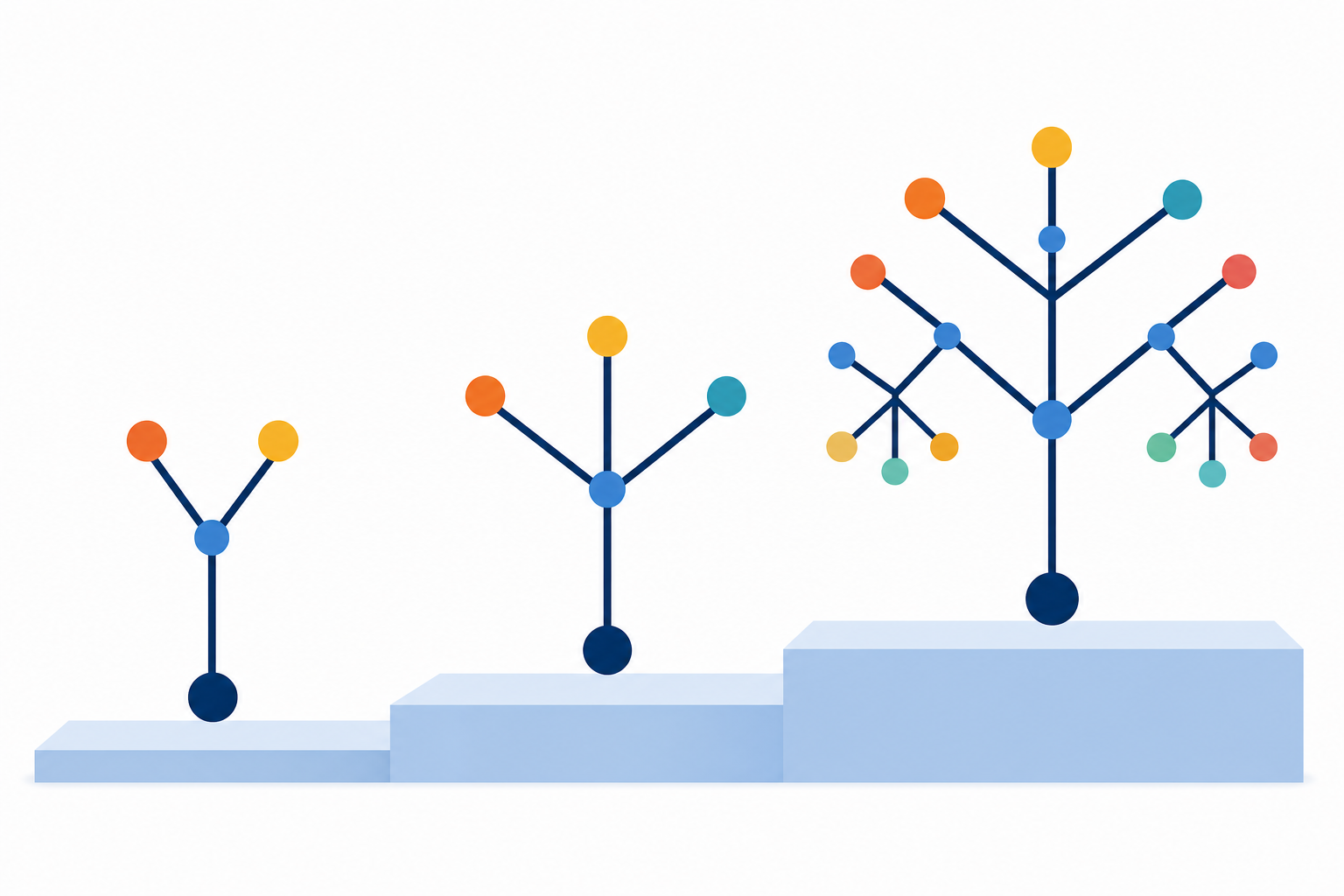
Step three, draw the ending tree, and calibrate its complexity to your experience. The realistic ladder, read off currently shipping series, looks like this: a dual-ending structure, one story with two possible outcomes across roughly forty episodes, is a sound first build; a three-branch title, with routes dedicated to different leads across a longer run, is the intermediate step; and a fourteen-branch detective thriller of eighty-seven episodes, with quick-time events and panoramic exploration stacked on top, represents the professional end. Blood on the Badge, the series carrying that fourteen-branch structure, is publicly listed with its introduction in the DRAMAGO library, and studying it is the fastest course in deep branching available.
Step four, add the interaction layer. Quick-time events put a countdown on a physical response inside action beats, and panoramic exploration lets the reader look around a scene for information before committing to a choice. Both mechanics reward an already-solid branch structure and expose a weak one, so they come last in the build order by design.
Common mistakes: choices that don't matter
Three failure patterns hollow out most abandoned interactive stories. The fake choice routes every option to the same scene, the unbalanced choice density buries readers in prompts or starves them, and the cosmetically different ending swaps one closing line while the route converges. Readers detect all three faster than creators expect.
The fake choice fails on the second playthrough. Route A and route B deliver the same scenes with different wrapping, and the reader who returns to test the fork discovers the trick immediately. The fix is structural: if a node's options cannot diverge downstream, delete the node rather than disguise it.
Unbalanced density cuts both ways. A prompt every scene exhausts the reader's attention and turns participation into labor, while a single decision in an entire story wastes the branch budget the format exists to spend. The workable rhythm places decisions at the emotional peaks identified in step two, which naturally spaces them by dramatic need.
Cosmetic endings betray the longest promise. Multiple endings that differ only in the final caption convert the whole branching apparatus into a coin toss over one line of text. The honest version makes each ending the settlement of decisions accumulated across the run, so the route the reader traveled is legible in the outcome they receive.
The positive proof that these fixes matter is commercial. User research on interactive drama ties meaningful, consequence-carrying choices directly to willingness to pay, and public viewer reviews of branching series return again and again to the pleasure of exploring multiple endings. Choices that matter are the product; choices that merely appear are the recall notice.
Tools and platforms: where interactive stories live today
Interactive stories ship in three main forms today. Text-first interactive fiction runs on general-purpose writing tools, vertical interactive drama packs branching narrative into short episodes on mobile platforms, and professional production lines increasingly blend AI workflow with human creative judgment. A creator's best entry point depends on which of the three forms the story wants to be.
Text-first interactive fiction remains the classic entry. General-purpose tools for branching text stories have existed for years and cost nothing to try, and for a writer testing whether branching suits their instincts, a short text prototype is the cheapest possible experiment. The mechanics translate intact from text to video, so nothing learned there is wasted.
Vertical interactive drama is the form this site knows. Short episodes of one to three minutes, typically two to three, a phone held in one hand, choices arriving at story nodes inside the video: the format packs real branch structures into commutesized sessions, and shipping titles prove the ceiling is high. The production reality behind such series is a professional pipeline, and internal estimates from DRAMAGO's own operation put a standard interactive series at ten to fifteen days of production and a flagship-tier branching title at around thirty. Those numbers describe an industrial process, but they also show the format is reliably manufacturable.
The role of AI in that pipeline deserves precision. AI agents now run inside the workflow, carrying efficiency and execution across production stages, while story structure, character building, shot language, and aesthetic judgment remain the professional creator's territory. The stated division is collaboration rather than replacement, and a creator planning to enter the field should expect to work alongside that division. The catalog pace it produces, roughly three new titles monthly, is publicly observable in the DRAMAGO library.
For a first project, the path of least regret: prototype in text, verify the branch tree with two or three readers, then decide whether the story wants to be read or watched. Either way, the four steps above hold.
Frequently asked questions
How many endings should a first interactive story have?
Two is the right first build. A dual-ending structure across a moderate run length proves the whole pipeline, node placement, routing, ending settlement, without demanding the content volume of a multi-route title.
How do I know if a choice is meaningful?
Apply the second-playthrough test. Replay from the fork with the other option, and if the following scenes diverge in events rather than wording, the choice carries weight. If nothing changes downstream, the node is decoration and should be cut or rewritten.
Do I need to write every branch in full?
You need to write every branch that the reader can travel, but branches can share scenes where the story converges naturally. Convergence is a legitimate tool; what fails readers is convergence so total that the branches were never distinct.
Can interactive stories work in video, or only in text?
They work in video, and shipping series prove it at scale. Short vertical episodes with choices at story nodes, up to fourteen branches in a single title, are live in the DRAMAGO catalog today.