Are Interactive Story Apps Good for Your Daily Commute? An Honest Look
A commute is a strange place to watch anything. The ride lasts twenty minutes to half an hour, a hand holds a rail or a strap, the tunnel cuts the signal, and the crowd decides how much attention survives the trip. Interactive story apps ask more of a viewer than ordinary drama, since a story that pauses for your decision needs a viewer who can give one. Whether the format fits the commute is a fair question, and the answer comes in three parts: the arithmetic of episode length, the places where the format genuinely helps, and the tradeoffs that deserve an honest admission before you commit a month of train rides to it. Examples throughout are drawn from DRAMAGO, an AI-native cinematic entertainment platform whose catalog pairs interactive drama with linear series.
The commute math: episode length versus stop-to-stop time
The arithmetic favors the format before any design detail enters. Episodes of one to three minutes, typically two to three, match the gap between subway stops, a half-hour ride clears ten to fifteen episodes, and a decision that holds the screen for a few seconds costs less than a missed transfer. Short vertical drama is structurally close to commuting itself.
Start with the unit. A single episode of a vertical drama series runs one to three minutes, typically two to three, which lands almost exactly on the distance between two stations on most metro lines. The watching experience comes pre-cut into commute-sized pieces, and DRAMAGO's own audience research points the same way: commutes, the stretch before sleep, and other fragments of dead time are the settings where this audience actually presses play.
Scale the unit to the whole ride. Thirty minutes of commuting buys ten to fifteen episodes, a quarter to a third of a full series in a single direction of travel. A week of round trips finishes most titles outright and leaves enough attention to start a second route through the same story, which matters more in this format than in linear drama, as the next section explains.
The interactive overlay costs surprisingly little inside that arithmetic. A story node appears, the video pauses, and a choice waits for a tap. The pause measures in seconds, the tap takes one, and the story resumes. Nothing in the interaction demands a desk, a quiet room, or a spare hand for longer than an elevator stop.
Where it works well
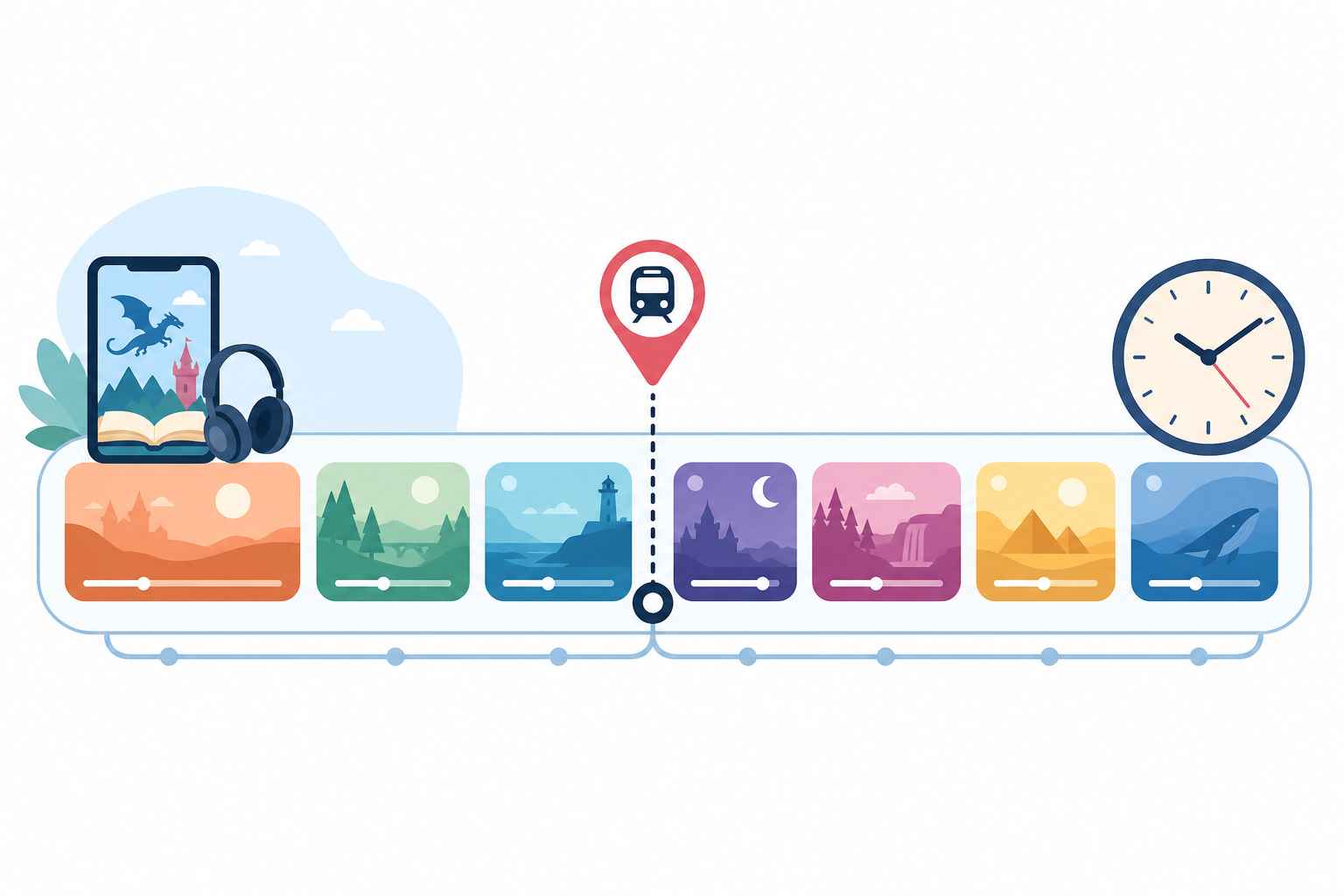
Three design facts do the real work on a train. Vertical video plays one-handed, a choice node is a natural stopping point that protects the story when your stop arrives, and multiple routes through the same series turn a repetitive commute into a different show every day.
One hand is enough. The video plays in portrait, the thumb reaches the whole screen, and the only interaction asked is a tap on one of two or three options. A commuter holding a rail with one hand keeps the other free for the entire experience, no landscape flip or two-handed control required.
A choice node doubles as a bookmark. Linear drama stops wherever the credits happen to fall, mid-scene if the doors open at the wrong second. An interactive series pauses at its story nodes by design, so ending a session at a decision point leaves the plot at a clean joint rather than a cliff edge. Public viewer reviews of interactive titles repeatedly mention the pull of exploring multiple endings, and that same pull is what makes an interrupted commute session easy to resume rather than frustrating to rebuild.
Repetition becomes replay. The same morning route, taken five times a week, turns repetitive in a way a single-route story cannot answer. A branching title answers it with route changes: the same commute, a different branch, a different ending accumulating toward the weekend. For a format whose audience keeps asking for more choices and deeper branches, the daily ride is the natural habitat.
The catalog to test this on is browsable before boarding, and the DRAMAGO drama library lists each series with its introduction, from dual-ending titles to a detective thriller carrying fourteen branches.
Where it doesn't: the honest tradeoffs
The format pays for its interactivity in three places on a crowded train. Video streaming consumes mobile data, packed cars make timed physical prompts genuinely awkward, and noisy surroundings soften the emotional immersion a strong scene is built to deliver. None of these breaks the commute case; all of them deserve to be known in advance.
Data is the first cost. Interactive drama is still video, and a half-hour ride streams ten to fifteen episodes of it. The short episode format keeps per-episode consumption far below what a full-length episode or a film demands, which is a real structural advantage, but the honest advice stands regardless of format: load up on Wi-Fi before the tunnel, because no mobile connection improves underground. On offline capability specifically, DRAMAGO's official descriptions make no promise of a download feature, so treat what the app itself offers as the truth rather than any claim made here.
Crowding is the second cost. Quick-time events, the timed physical prompts inside action beats, ask for fast input at an unchosen moment. On a packed car with one hand on a strap, that is the wrong moment. Story choices behave better in the same squeeze, since a decision node waits rather than times out, and the distinction between a waiting prompt and a counting-down one is exactly the line between commute-friendly and commute-hostile interaction.
Immersion is the third cost, and the least fixable. A quiet, emotionally heavy scene lands at full force at home and at maybe half force over announcements and tunnel noise. The story still plays, the branch still records, but a viewer measuring the format by its strongest scenes should expect those scenes to arrive at full volume on the sofa rather than the platform edge.
The verdict for commuters
Interactive story apps suit a commuter whose travel time is predictable, who accepts a small unlocking cost past the free stretch, and who wants the ride itself to move a story forward. A viewer who only wants to decompress after work is better served by linear short drama, and both preferences have a home in the same catalog.
Three conditions mark the fit. A stable travel window, roughly the same ride at roughly the same time, gives a branching story room to build. A tolerance for the paywall's arithmetic, where the opening stretch plays free and later episodes unlock with in-app credits, keeps the commute from stalling mid-route. And a genuine taste for participation, the feeling that a decision made on a train is worth the seconds it takes, is the condition that carries the rest.
If those conditions hold, the commute converts from dead time into story progress, one branch at a time. If they do not, linear drama asks nothing and delivers its pleasures unconditionally, which is its own kind of excellence.
DRAMAGO runs both formats side by side, linear AI live-action drama for the no-decisions ride and interactive series for the participatory one, so the preference decides the row. The practical test costs one morning: open a title during the ride, reach the first real choice, and notice whether the arrival of your stop feels like an interruption or a save point.
Frequently asked questions
How many episodes fit into a typical commute?
At two to three minutes an episode, a thirty-minute ride clears roughly ten to fifteen episodes. A standard five-day commute schedule finishes most series within a week and a half.
Do choices work when the train is packed?
Story choices do. A decision node pauses and waits for a tap, which suits one-handed use. Quick-time events, with their countdowns, are the part of the format better saved for a seat.
What about signal loss in tunnels?
Short vertical episodes consume less data than long-form video, but streaming still needs a connection. Loading content on Wi-Fi before the ride is the reliable approach, and offline behavior should be judged by what the app itself offers rather than assumed.
Is a linear series better if I just want to relax?
Often, yes. Linear drama asks for no input and plays one fixed route to one ending, which suits a tired commute. Interactive series reward attention with routes that change, and the DRAMAGO catalog holds both formats for exactly this difference of mood.