Apps Like Choices: Best Picks for Readers Ready to Watch Their Stories

The short answer: two families of apps like Choices
Every search for apps like Choices is quietly asking one thing: which form should carry the choosing habit you already have. The market answers in two families, the text-first interactive reading aisle where Choices, Chapters, and Episode live, and the filmed interactive drama aisle where DRAMAGO works, and the pick depends entirely on which texture you want next.
If you have spent a season making decisions inside a reading app and now want to watch those decisions performed instead of printed, you are the reader this page is written for. If you would rather keep reading prose, the reading family remains a perfectly good home, and nothing here will try to pull you out of it; the aim is a clean match, not a conversion pitch. That is why the question underneath apps like Choices is not which product ranks first, a ranking this page does not attempt, but which form can hold the habits you already exercise: deciding, branching, replaying.
The direct answer: the apps resembling Choices divide by carrier. In the reading family, choosing happens in words on a page. In the filmed family, choosing happens on screen, inside an AI interactive drama. DRAMAGO stands in the second family, and its catalog was counted at 14 AI live-action dramas as of October 16, 2026, with ten of those entries carrying interactive mechanics.
| Family | Where the choosing happens | Carriers |
|---|---|---|
| Text-first interactive reading | On the page, inside prose | Choices, Chapters, and Episode, named at category level |
| Filmed interactive drama | On screen, at story nodes | DRAMAGO, an interactive drama app; 14 AI live-action dramas on the shelf, 10 of them interactive, as of October 16, 2026 |
One line of honesty before the matrix: the reading column below stays at category level throughout. This page describes what the text-first form does by definition, choosing inside a written story, and makes no claims about any single product's features, libraries, or reputations, because those details sit outside what can be verified here.
The migration matrix: reading vs watching, dimension by dimension
The matrix lines both families up across four dimensions: the story's material, the choice mechanism, the session rhythm, and where each form lands you. The reading column stays at form level by design, and the filmed column carries the concrete anchors, episode lengths, branch counts, and the one honest caveat about unverified mechanics.
| Dimension | Reading family, text-first | Filmed family, DRAMAGO side |
|---|---|---|
| The story's material | Words on a page, with your imagination casting the scenes | AI-generated filmed frames, vertical and episodic |
| The choice mechanism | Deciding inside the written story, as the form's own name implies | Choices at story nodes that steer the story's direction and your experience, with route-level weight in three tiers |
| The session rhythm | Your reading pace sets the tempo | Episodes of two to three minutes, shaped for commutes and bedtime windows |
| Where you land | In place, if the page is the point | In the filmed family, seated by the chart further down |
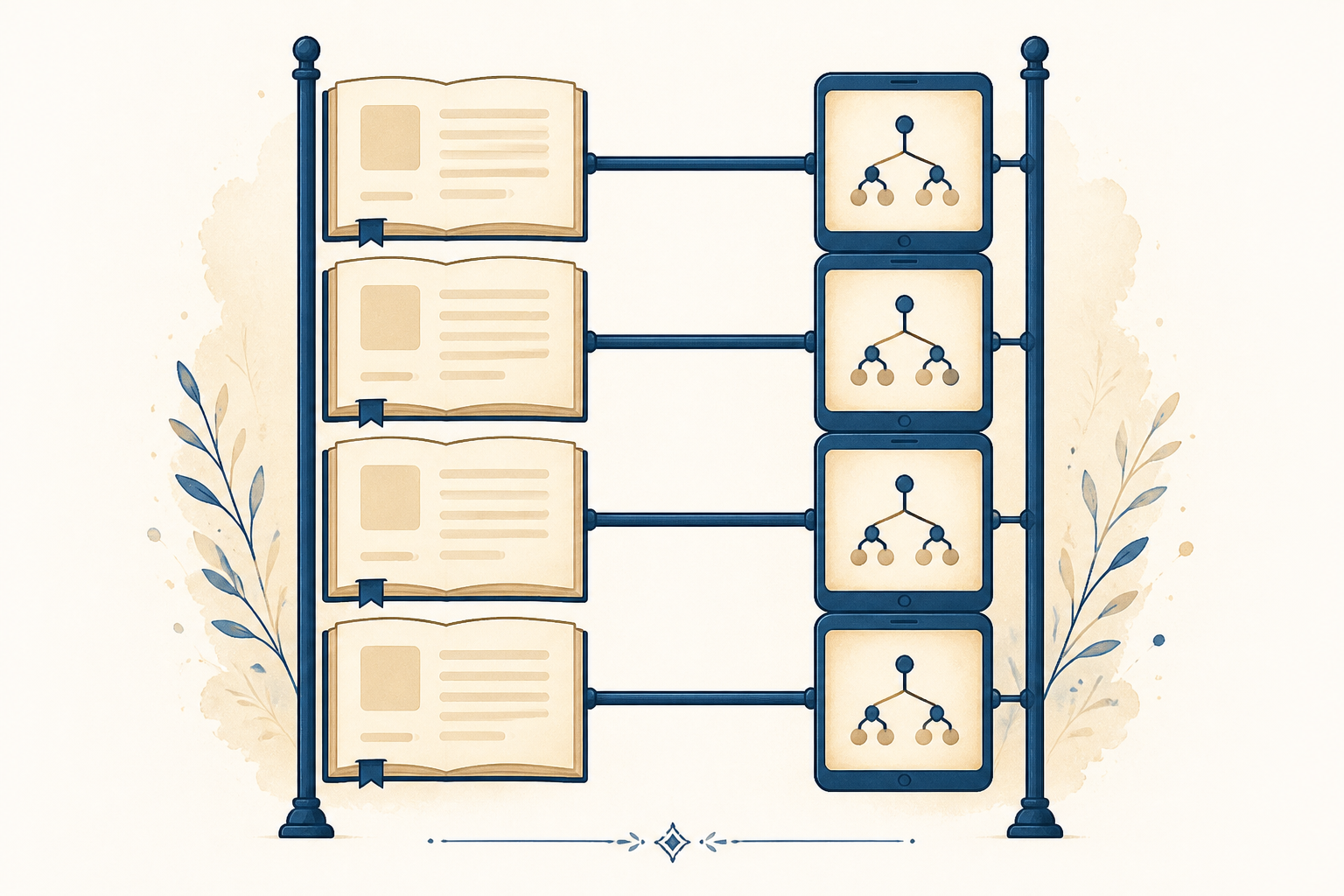
Two rows deserve their detail spelled out. On material, the filmed side needs one glossary note: the phrase live-action, in this catalog's usage, names the format's look, a filmed-drama texture, rather than a physical shoot, so the frames are AI-generated and nothing on this page promises real actors. On mechanism, the route-level tiers run from a two-ending finish on The Queen's Taming Rules, through three route lines on Sterling Lies, up to 14 branches across Blood on the Badge; that flagship also adds QTE quick-reaction events and panoramic scene exploration, both newly shipped and both still pending verification of their effect, which is a different status than proven.
Whether interactivity holds attention is at least measurable inside one platform. Internal platform data as of October compares interactive titles with the platform's non-interactive AI live-action titles: 1.95x completion across the opening three episodes, 30x conversion at the first paywall, 2.59x retention at the seven-day mark, and 1.52x watch time. The plain-language reading: viewers who hold the steering stay in the seat longer.
None of this demotes the reading family. A page leaves room for an imagination that a fixed frame cannot, and a reader who treasures that room has every reason to stay. The matrix only separates what moves from what stays put.
The migration verdict: The habit of choosing travels intact; only the texture changes, from words on a page to a story filmed on screen.
What carries over when you switch
Migration earns its name only if something survives the trip, and three things do: the steering reflex itself, the appetite for alternate endings, and the genre tastes you already read for. Each has a concrete anchor on the filmed side, and each arrives with its honest edge noted.
The steering reflex transfers because the contract is the same. The platform's stated position on its interactive drama is that choices land at story nodes and shape both the story's direction and the experience of it, with interaction serving the story rather than performing for its own sake, which is the same expectation a choosing reader brings from any text-first title.
The ending appetite is documented, not assumed. Audience research on this population reads high-freedom branches and repeat runs as the strongest retention lever in the format, and the filmed shelf answers with the three-tier spectrum above: two endings, three route lines, and a 14-branch grid for the completists.
The tastes travel as baggage. The profile that shows up in this readership, fantasy romance with wolves and vampires, underdog reversals, push-pull longing, suspense that turns late, maps straight onto the filmed catalog: I Stole My Sister's Billionaire Alpha for the contract-marriage wolf romance, The Queen's Taming Rules for fantasy transmigration, Blood on the Badge for the crime-minded.
One finding from the payment side deserves a sentence because it protects the migrant too: audiences proved willing to pay for interaction that genuinely steers, while mechanical, inconsequential choices fatigue people fast. A reader who switches for real consequences is switching toward the thing the platform says it is built around.
Two edges keep the promise level. DRAMAGO is not a text reading app, so a reader who wants prose should stay in the reading family, full stop. And within the filmed shelf, most A-tier entries spend your decisions on experience and relationship shifts rather than on alternate finales; the ending-changing builds are the three named above, and the rest are labeled exactly that way in the seating chart.
The carry-over benchmark: Deciding, branching, replaying: what you loved in a reading app is precisely what an interactive drama app keeps.
Where to land: picks by what you liked in reading apps
The chart turns migration into four entry criteria, each keyed to something you already liked in a reading app, and each row names concrete titles with their fields. Honest labels ride along wherever a title lacks a branch tree, because a seating chart only helps when every seat tells the truth about itself.
| If reading was where you liked... | Your seats | What the row gives you |
|---|---|---|
| Daily choices and slow-burn affection | Taste of Plus Love, 40 episodes; Your Highness, Come Ashore, 40 episodes; Forbidden Rules to Tie a Princess, 30 episodes | A-tier interactive drama with story choices and character interaction; no branch tree, labeled as such |
| Choices that settle how things end | The Queen's Taming Rules; Sterling Lies, 74 episodes | A two-ending finish; three route lines to walk |
| The densest possible decision load | Blood on the Badge, 87 episodes | 14 branches plus QTE and panoramic scene exploration, the two new mechanics still under verification |
| Crime and suspense storylines | Blood on the Badge | The crime-suspense entry of the interactive shelf |
The route that suits most migrants runs top to bottom: an A-tier title first to test the performed-choices feel, a two-ending or three-branch build once decisions should count, the flagship when density is the point. Every seat is browsable in the DRAMAGO drama library, where each series page states its branch structure up front.
The seating rule: Match the pick to what you actually miss, the words or the faces.
FAQ: switching from Choices-style apps
Five questions cover the switch: whether DRAMAGO resembles Choices, whether the choosing survives the medium change, how endings are distributed, whether you read or watch, and where Episode and Chapters fit once the dust settles.
Is DRAMAGO like Choices?
Same genre of participation, different medium. Choices-class titles are text-based interactive reading, while DRAMAGO is an AI-native cinematic entertainment platform whose titles center on what you watch and hear rather than on text you read, so the reflex transfers and the carrier changes.
Can I still choose what happens?
Yes. Choices arrive at story nodes and shape the story's direction and your experience of it, and on three titles they go one step further and settle different finales.
Are there multiple endings?
They concentrate in three builds: the two-ending finish on The Queen's Taming Rules, three route lines on Sterling Lies, and 14 branches on Blood on the Badge. The remaining interactive titles spend choices on experience and relationship shifts without re-routing the ending, and their pages say so.
Do I read or watch?
You watch. Stories arrive as AI-generated filmed episodes of two to three minutes each, framed vertically, and the term live-action refers to the filmed look of the format rather than to a live shoot.
What about Episode or Chapters?
Both belong to the text-first reading family, and this page names them at category level only, with no feature-by-feature comparison, no ratings, and no ranking. Readers who want the written form should stay in that family; readers who want the performed form have the seating chart above.
One boundary note for completeness: a reader whose starting point was a steered film rather than a reading app is arriving by a different road, and that comparison has its own home elsewhere in this cluster. To get started, and to see how the choice prompts behave in practice, the official guide page walks you through setup, and the interactive story complete guide maps the wider territory this page hangs from. Readers who want to know where the format is heading next can follow the story worlds page, where the first world, Deadwood, is now in closed beta and launching soon.