Interactive Story: The Complete Guide to Making and Playing Stories You Can Steer

Interactive story, in one map
An interactive story is a story that pauses at decision points and asks the audience to choose, and every choice steers what happens next, which scenes play, and how the story ends. A conventional series hands you one fixed route from opening to finale. An interactive one hands you a map, and you walk it yourself. On DRAMAGO, an AI-native cinematic entertainment platform, the official mechanics run six deep: story choices, multiple endings, AI face swap, character interaction, quick-time events, and panoramic scene exploration.
That map is not a gimmick, and the platform's own numbers say so. Compared with regular dramas, interactive titles clear the first three episodes 1.95 times more often, convert at the first paid node 30 times more, hold D7 retention 2.59 times higher, and log 1.52 times the watch time. A choice that matters is the difference between a viewer who stays and a viewer who comes back.
The library those mechanics live in is concrete. As of September 2026 the catalog holds thirteen AI live-action dramas, nine of them interactive, running from a dual-ending title to a detective thriller of 87 episodes across 14 branches. The rest of this page answers one decision question in two directions: on the creation side, how do you write and build one of these, and on the playing side, which one do you pick and how do you get in. Browse the drama library to see the titles behind the numbers, then use the cards below to go deeper.
The creation checklist. Make an interactive story game with a checklist walks the seven-step build order, from world and mainline to anti-deadlock testing.
Making a drama with AI. How to make an AI drama covers the branching script tree, the prompt pipeline, and the final grade.
Using an AI drama app. How to use an AI drama app covers cost, languages, and the store entry points.
No modeling skills required. Making one without modeling skills maps the zero-background on-ramp into the craft.
Real actors, AI-native shorts. Drama shorts with real actors explains how the human performance survives the AI pipeline.
Endings that hold up. Multiple endings that hold up reads branch count as a promise and shows how titles keep it.
Branch design first. How to make an interactive story starts with the branch as the load-bearing wall.
Idea to script. How to create an interactive story runs the full chain from premise to branched draft.
Mechanics and loops. How to make an interactive story game turns a branching script into something with a game's grip.
The modern production path. How to make a drama covers the traditional craft sitting beside the AI efficiency layer.
The app format, defined. What an interactive short drama app is names the nodes, choices, routes, and endings.
Where choices matter. Short drama apps where choices matter gives the three tests that separate a real choice from a decorative tap.
Picking the best app. Best interactive drama apps ranks the interactive shelf by choice depth.
The story after the episode. Character chat in interactive drama apps covers talking to the characters when the episode ends.

AI-native drama: the new production path
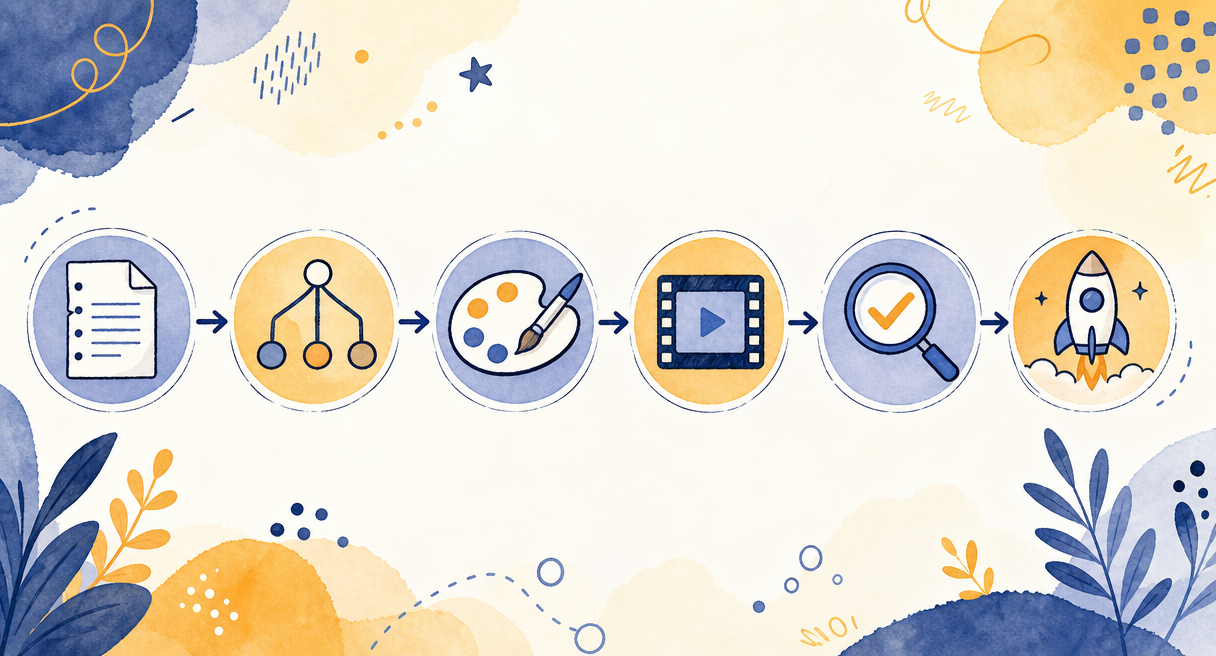
AI-native drama is a production route where AI participates in how content is made and expressed, not a traditional pipeline with AI bolted on at the edges. On DRAMAGO the people steering it come from live-action film and television: directors, cinematographers, lighting artists, and post-production editors who moved their craft onto an industrialized AIGC line. A single title runs through six stages, from the writer's room, where a world, its branching story tree, and its key choice points are fixed, through asset building, directorial script breakdown and generation, post, multi-role review, and release. Three self-built platforms carry the load along the way, one for asset management, one for production collaboration, and one for multi-role review. The AI carries speed and execution; story structure, character, shot language, and aesthetic judgment stay with the professional creators.
The calendars make that division concrete. A standard A-tier interactive series runs ten to fifteen days of production, and a flagship S-tier title runs about thirty, by the platform's internal estimates. The result is a library that ships new interactive titles on a steady rhythm while keeping a human eye on every frame.
How to make an AI drama
An AI drama starts with a branching script tree, not a prompt. The writer's room fixes the world, the branches, and the decision points before any asset is generated, and only then does the toolchain take over. The named tools are a matter of record: DeepSeek and GPT assist the script, Midjourney shapes concepts, Seedance generates video, and DaVinci Resolve carries the color grade for a unified look. Read the full build path to follow the stages in order.
How to use an AI drama app
The practical side is simple. The app first reached the App Store in November 2024 and arrived on Google Play in March 2025, and the app interface is available in nine languages. The opening episodes play free; past them, the rest unlocks with in-app credits. For the finer points of languages and payment, see the FAQ, and read the full walkthrough for the store and account details.
Making one without modeling skills
No modeling background is required to enter this craft, because AI's real value here is leverage. When the technical floor drops away, what separates work is story sense and audiovisual taste, not 3D or camera training, so the entry points that remain are the writer's room for world and premise and the existing industrial pipeline for execution. On the user side, the same idea shows up as a feature: AI face swap, live since February 2026, lets a viewer upload a face into selected scenes of a title to replace a character. Read the zero-background route for the full picture.
Formats that change how stories end
The same interactive core splits into two shapes. One is a performance shape, where real human faces and bodies carry the story on screen. The other is a structural shape, where branching determines how many ways the story can finish. The hard data anchors sit in the DRAMAGO catalog: Sterling Lies carries 74 episodes over three branch lines; Blood on the Badge stretches 87 episodes and 14 branches, adding timed events and panoramic scenes; and The Queen's Taming Rules holds 40 episodes to exactly two endings.
Real actors, AI-native shorts
"AI live-action drama" is the umbrella term for the whole library: thirteen titles, all of them AI live-action, nine of them interactive. Live action here names the “format's look” — filmed-drama texture and performance-scale storytelling — rather than a physical set: the titles are produced on AI pipelines, and the crew behind them came from traditional film and television, translating directing, cinematic framing, and lighting into an AI workflow. The human performance is the aesthetic center of the format, which is why the platform keeps that craft in professional hands rather than outsourcing it to the machine. Read the full account of how the performance survives the pipeline.
Multiple endings that hold up
A branch count is a promise, and the catalog keeps it in measurable form. Sterling Lies splits three ways, The Queen's Taming Rules closes on two, and Blood on the Badge spreads 14 branches across 87 episodes. The user-side evidence lines up with the design: viewers in the platform's own research keep naming multiple endings and high-freedom fate branches as what pulls them back for another run, and public review threads return again and again to the pleasure of exploring an ending they had not seen. The inverse is just as telling, because a mechanical choice that changes nothing reads as fatigue, while a choice that genuinely reroutes the plot is what earns the next episode. Start with the deepest branch and see the ladder laid out.
The build checklist
The full seven-step checklist lives on its own page. The first three steps preview the whole idea. Step one fixes the world and the mainline: the core premise, the genre and tone, the branching story tree, and the key choice points marked for quick-time events and hidden clues. Step two breaks out the asset list: character faces, expressions, and costumes, scene day and night lighting, and props. Step three closes the branch-decision loop and tests against deadlocks, which is a review-gate item. The order is the production pipeline turned into a plan you can follow. Take the checklist.
The classic creation guides
Four classic how-to guides already cover the creation side end to end, and they share one knowledge base: interaction serves the story, and it is never there for its own sake. The writer's room always fixes the world, the mainline, and the branching story tree before anything else moves.
Branch design that matters
Branch, choice, and ending design is the core of the craft, and the shipped sample is Sterling Lies, whose three branch lines for Sander, Julian, and Leo are a working demonstration of branches that change whose eyes the story travels through. Read the branch design guide.
From idea to branched script
The chain from premise to outline to branches to a finished draft runs on the writer's room step: a world, a networked narrative outline, and a computed feel for the player's flow and emotional curve. Read the script route.
Mechanics, loops, and branching
Game feel plus cinematic storytelling drives the design, and the three-mechanic set has a shipped instance: Blood on the Badge runs quick-time events, panoramic exploration, and branching together. Read the mechanics guide.
The modern production path
Traditional craft and the AI efficiency layer coexist, and the numbers are stark. By internal estimate, full-pipeline AI production cuts hard costs by more than 80 percent, and a 120-minute body of footage finishes in three to seven days, with 30 to 40 percent asset reuse. Read the full production path.
Playing and picking
The consumption side answers four questions in four delivered guides: what to watch, how to judge whether a choice carries weight, which app to pick, and how to keep talking to the characters after the finale. The DRAMAGO library snapshot bears repeating with its time qualifier: as of September 2026, thirteen AI live-action dramas, nine interactive, with roughly three new titles arriving each month.
The app format, defined
The format runs on nodes, choices, routes, and endings, and the library numbers stay concrete at thirteen total and nine interactive. Read the definition.
Where choices actually matter
The test of a choice is whether it reroutes what follows, and the platform's willingness-to-pay research plus its category-comparison data both point the same way: interaction that genuinely changes the story is what earns payment and retention. Read the three tests.
Best interactive drama apps
The on-site ranking keeps it clean: it sorts the interactive shelf by choice depth and names no competitor platforms, because comparison lives on third-party review pages, not here. The titles themselves are the evidence, from The Queen's Taming Rules to Sterling Lies to Blood on the Badge. Read the ranking.
Character chat: the story after the episode
Character chat is the AI-driven conversation with a character from a series, the extension of an interactive drama that keeps the world present between episodes. The billing is honest: character chat ships inside the app and is not sold as a separate tier, and chat sessions draw on in-app credits. Read how character chat works.
What comes next: from series to story world
The road ahead runs in four steps: Watch, Choose, Interact, and Enter the World. The first AI story world, Deadwood, a DRAMAGO story world, extends the world of Blood on the Badge and is coming soon. The entry point is the interactive drama, not character interaction, and the launch details will follow the official announcements. The main line holds it together: the story doesn't end when the episode ends. Explore on the official site for the latest, or browse the library that this world grows from.
From the press
Four third-party pieces sit around this cluster, two already live and two on the way.
- Beyond Streaming (published September 4, 2026): a media commentary on what Blood on the Badge reveals about AI-native entertainment.
- From Passive Viewing to Participation (published September 4, 2026): a look at how AI is turning viewers into participants.
- Best AI character chat (forthcoming): a third-party comparison of character chat by format and story depth.
- Awards Daily commentary (forthcoming): a media review of Blood on the Badge for a film and television audience.
The cluster also connects outward. For the short drama category as a whole, the sibling hub short drama app covers the broader shelf this interactive cluster sits inside.