Best Branching Story Apps: How Big a Story Tree Do You Want?
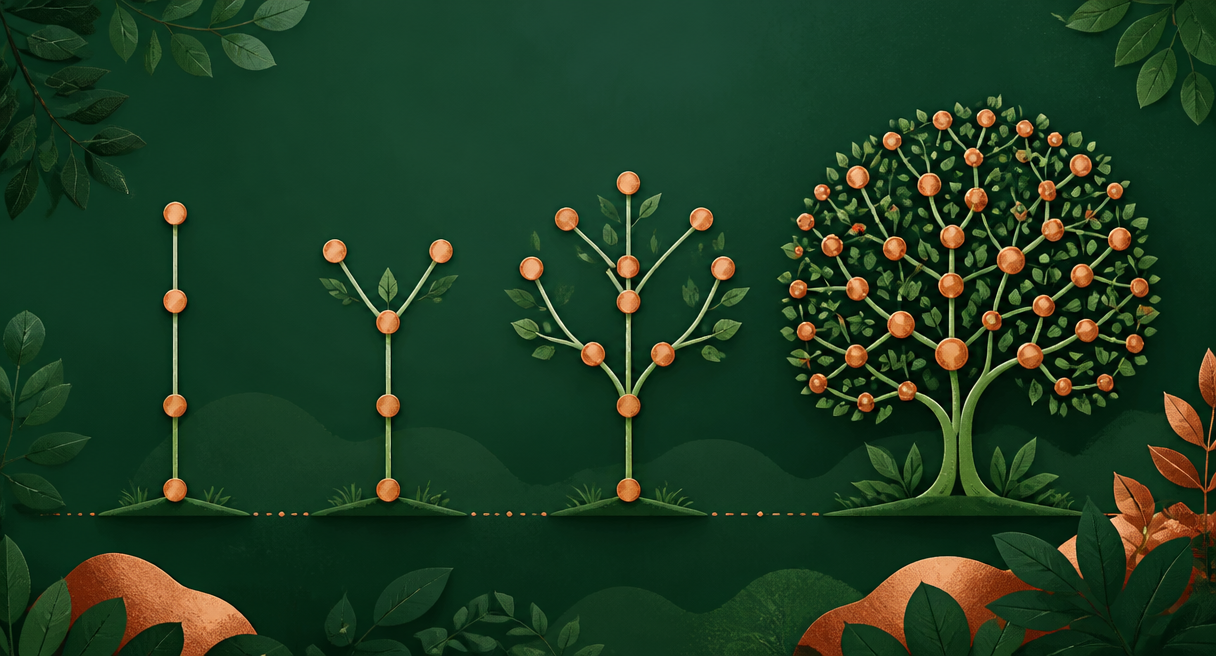
Quick take: how big is the story tree
Judging branching story apps gets simpler the moment you measure the one thing that defines them: the size of the story tree. Trees come in four sizes on one spectrum, from a single unbroken spine through a two-ending fork and a three-route split to a 14-branch grid, and the right app is simply the one whose tree matches your appetite.
This guide is for people who love branching narratives and want to size the tree before installing anything: the multi-run readers and alternate-fate chasers. One scoping note before the table: this phrase's search intent leans toward interactive novels and visual novels, text-shaped and reading-driven; if that is you, the text-first aisle of adjacent reading tools is yours, with no comparison attempted here. DRAMAGO plays one segment of the branching spectrum, the filmed interactive drama, and claims nothing beyond it. The verified snapshot from October 16, 2026 puts 14 AI live-action dramas in the library, 10 of them built to take your choices, and those ten are the raw material for the spectrum below.
| Tree size | What it gives you | The entry |
|---|---|---|
| Single spine | One unbroken storyline, with optional beat choices | 4 linear titles plus 7 A-tier beat-choice builds |
| Two endings | One fork that matters, two possible finales | The Queen's Taming Rules |
| Three routes | Branch lines keyed to characters | Sterling Lies |
| 14-branch tree | The widest fork grid, plus timed calls and explorable scenes | Blood on the Badge |
Multi-ending architecture, where a run can close on a different finale, belongs to exactly 3 of the 10 interactive builds, carried here as inventory rather than slogan.
Spectrum rule: Size the tree first; the app choice follows on its own.
The small end: single spines and beat choices
The small end of the spectrum is the single spine, and it arrives in two shapes. Four titles on DRAMAGO run purely linear with nothing to decide, and seven A-tier interactive titles wrap one main storyline in beat-level choices, which change the ride without ever re-routing the destination.
The purely linear four: A Crown of Venom, spread across three seasons and 62 episodes, and My Mind, His Playground at 40 episodes, titles you simply watch, no prompts, no pressure. The beat-choice group is seven A-tier builds, among them Taste of Plus Love (40 episodes), Forbidden Rules to Tie a Princess (30), and their shelf mates, whose interaction columns read story choices plus character interaction, with no branch tree and no alternate ending. What your decisions buy there is experience and relationship texture: a scene plays warmer or colder, a bond deepens or snaps, and the finale arrives where it was always going to arrive.
The strengths of the small end are real. It is the lightest on-ramp for a first interactive title, the emotional lines run dense because character interaction is in every column, and nothing about finale management interrupts the story. The limit is the mirror image: the tree never swaps its ending, so a viewer hunting alternate fates needs to walk up-spectrum. Audience research notes the stakes: mechanical, low-stakes picks fatigue viewers fast.
Small-end verdict: A single spine still bends, and beat choices change the ride, not the destination.
Where the tree forks: two endings, three routes
The middle of the spectrum is where consequences become architectural. Two builds carry route-level forks: one drama closes on a choice of finales, and one splits its mystery into branch lines you select by character. Together with the flagship they account for every multi-ending title in the catalog, three of ten, treated here as inventory, not slogan.
The Queen's Taming Rules, A-tier at 40 episodes and live since June 9, 2026, is the two-ending build: one run delivers one finale, and a second run can close on the other. Sterling Lies, S-tier at 74 episodes and live since April 3, 2026, splits three ways down named character lines, the Sander route, the Julian route, and the Leo route, so the fork asks not when but who. Replay is the engine at both sizes: the platform's audience findings rank high-freedom fate branches and multi-run replay as this format's strongest retention drivers.
The honest limits sit close to the strengths. The dual-ending drama offers exactly one consequential fork, no more. On the three-route side, how each route closes is not documented in the platform's records, whether every line lands its own finale has no published answer, and the series page inside the app is the authority this page defers to instead of guessing. Access runs one structure across the spectrum, with two details kept straight. Free-labelled dramas stay free throughout, and every other drama opens with free episodes before credits take over; once a title moves into the member area, a weekly, monthly or yearly pass covers it in full, and non-members can still unlock it with credits. Per-title specifics sit on each series page in the app, and S-tier titles such as Blood on the Badge may carry their own paid play design. To climb the spectrum yourself, seat your next series by fork size in the DRAMAGO drama library.
Fork verdict: Two endings ask you to choose once; three routes ask you to choose who.
The big end: a 14-branch tree
The big end belongs to one title. The S-tier crime flagship Blood on the Badge, 87 episodes, live since August 15, 2026, holds 14 branches, the deepest fork count in the catalog, stacked with story choices, character interaction, timed-reaction events, and panoramic scene exploration, an interaction column with more entries than any other listing on the shelf.
The two newest grains deserve their definitions. Quick-reaction events are choices on a clock, a handful of seconds to commit before the story moves on. Panoramic scene exploration is scene-level discovery: the frame becomes a space you survey for your own focal points rather than a window that only follows the camera. Both mechanics arrived first on this title, and the official word on both is unchanged: effect still being verified, counted here as architecture, not proven magic. One design note: the branching outline is drafted at the script stage, with key decision points, timed calls, options, and hidden clues marked into the netted synopsis, stated as design intent only.
The big end's limit is structural arithmetic: one title holds up this entire rung, and the finer the grains, the fewer the entries that carry them. The forward note belongs here too, because the biggest tree is also the one growing outward: the flagship's world stretches into Deadwood, a DRAMAGO story world, the platform's first AI-powered story world, and it is now in closed beta and launching soon.
Big-end verdict: The widest tree on the shelf is also the newest, and its newest branches are still being tested.

What "branching story app" usually means
Three calibrations keep this page honest. The phrase branching story apps carries search intent shaped by text formats, the dramas here are filmed branching narrative rather than prose adventures, and no branching app on this spectrum hands you a writing instrument. Together they prevent the most common buyer's remorse in this category.
First, intent versus format. Search results for this phrase tilt toward interactive novels and visual novels, reading-driven products where the branching lives in text. DRAMAGO's format is branching drama, filmed: AI-generated life-like frames on AI pipelines, with choices, branches, and endings built into episodes that play like television rather than like a page. No choose-your-own-adventure prose format is offered here, and no self-authored branch system either; readers who want text-first shapes have a separate aisle of adjacent reading tools, unranked here.
Second, branching is not free generation. The forks and the replays are pre-produced content, every route was built before you arrived, and walking them is choosing, not authoring. Your identity runs viewer, then chooser, then participant in a story that already exists, with no creator role on offer and no plot-generation claims made here.
Third, tree size is an asset count. A 14-branch tree exists because an S-tier production of 87 episodes was built to hold it, and the spectrum tops out where the shelf does, at real titles with real footage, not at an infinite sandbox.
Calibration verdict: A branching app offers forks that were produced, not forks you write.
Pick your tree size
The spectrum compresses into one boarding table, four rungs keyed to what you want from a run rather than to feature lists. Every entry comes from the same shelf and is judged on the same criterion, tree size, with the recommendation hanging on a scenario verdict rather than on an abstract ranking.
| Tree size | Pick it when | Load this |
|---|---|---|
| Single spine | First interactive title, or zero finale management | My Mind, His Playground (40); A Crown of Venom (62, three seasons); Taste of Plus Love (40); Forbidden Rules to Tie a Princess (30) |
| Two endings | One run, one finale, swap it on the next | The Queen's Taming Rules (40) |
| Three routes | Loyalty to a character line | Sterling Lies (74, Sander, Julian, Leo) |
| 14 branches | The whole grid, newest grains included | Blood on the Badge (87, timed calls and panorama, pending verification) |

The climbing order writes itself: sample the small end, where beat choices teach the mechanic without finale pressure; step up to the dual-ending build when you want a finale you chose, and to the three-route mystery when the question becomes whose line you walk; take the top rung when only the full grid will do, its two newest grains still experiments in progress. Fork fields for every title sit in the DRAMAGO drama library.
Boarding order: Pick the tree before you pick the app.
FAQ: branching story apps
Five questions cover the ground this page gets asked about most: whether choices move endings, what a branch count means, how the format relates to reading apps, whether you can author branches, and which tree is currently the largest.
Do my choices change the ending?
It depends on the rung. Single-spine builds, both linear and beat-choice, spend your decisions on experience and relationships, and the finale stays put. Route-level ending swaps live on exactly 3 of the 10 interactive titles, the two-ending build, the three-route build, and the 14-branch flagship, and the rest say so plainly on their series pages.
What does "14 branches" mean?
It is the branch count from the flagship's interaction column. It is not a promise of 14 endings and not a route count; the details of how forks resolve sit on the series page in the app, which is the authority on the exact mechanic.
Is this like the interactive reading apps I have seen?
Those are text-first products where the branching lives in prose. This format is filmed branching drama: AI-produced episodes with an audiovisual experience at the core rather than text reading, and no comparison or ranking between the two shapes is attempted here.
Can I write my own branches?
No. The branches are pre-produced filmed content, and you are the chooser, not the author. The farther destination on this platform is a story world rather than a writing tool: Deadwood, a DRAMAGO story world, is now in closed beta and launching soon.
What is the biggest tree right now?
Blood on the Badge, an S-tier interactive drama of 87 episodes holding 14 branches, the highest branch count of any entry in the catalog.
For how the prompts and forks behave in practice, consult the official setup guide. This article belongs to the interactive story complete guide hub; readers whose focus narrowed to endings can take the best drama with multiple endings roundup, and those wondering how much control they hold get the map at apps where you choose what happens.