Best Cinematic Interactive Story Apps: Three Rulers for the Film-Grade Look

Quick take: three rulers
Every app in this category claims to look like real cinema, and the claim is testable. Three rulers do the testing: whether the picture carries filmed-drama texture held to film-crew standards, whether the camera directs attention with intent, and whether faces and places hold steady across episodes and forks. Run all three before installing anything.
The readers this page serves are viewers who want interactive stories that genuinely read as filmed series, especially anyone previously burned by rough AI visuals that turned a promising premise into a slideshow. Two non-fits early: if you are after text-form interactive novels, that reading aisle is adjacent and untested here; and if only physically shot series count as cinema for you, the calibration section matters more than the rulers. The shelf underneath the rulers: 14 AI live-action dramas, 10 interactive among them, counts checked against the catalog on October 16, 2026.
One vocabulary note, because it governs everything. Live-action, in the platform's own framing, names the look of the format rather than a physical production: filmed-drama texture and storytelling at performance scale, produced on AI pipelines by people who built their careers in traditional film and television.
| Ruler | What it measures | Where DRAMAGO stands |
|---|---|---|
| Picture quality | Filmed-drama texture held to a film-crew bar | Principals from traditional filmed production; film-grade grading unified across branches |
| Camera language | Whether shots breathe and compose with intent | Director staging, cinematic framing, and lighting logic rebuilt as an AI workflow |
| Scene continuity | Faces and places holding across episodes and forks | Cross-branch character consistency control plus multi-seat review and repair |
Ruler rule: Cinematic is checkable, and three rulers do all the checking.
Ruler one: picture quality
The first ruler measures texture. DRAMAGO's stated bar for film-grade content is that a professional film team's standards govern the story, the characters, the narrative, and the visual delivery, and that no efficiency gained through AI lowers that bar, which makes the quality claim a policy rather than a mood.
Two facts anchor the ruler. The core team spent years in traditional filmed production, and its principals arrived from the front line of live-action shoots, senior directors, directors of photography, lighting specialists, and post-production crews, now working inside an industrialized AIGC pipeline. The craft anchor is specific: film-grade color grading in DaVinci Resolve unifies temperature and light-to-shadow contrast across the shots of different branches, so a fork does not fork the color script.
The live-action sentence sits here because picture quality is where the misunderstanding strikes. Live action, as DRAMAGO's own definition runs, names the look of the format, filmed-drama texture plus storytelling at performance scale, rather than a physical set: AI pipelines produce the titles, and the crews behind them built their careers in traditional film and television. The look is the deliverable; the backlot is not part of the claim, and honest copy in this category never says otherwise.
The balance side of the ruler is stated rather than buried. Viewer feedback records quality fluctuation on individual titles, so this page claims texture policy rather than uniform perfection, and the most frequent technical question there, whether the titles are really AI-made, gets the straight answer: yes, produced on AI pipelines, with creative standards held by film-trained people.
Texture verdict: Cinematic names a look held to film standards, never a claim that anyone lit a physical set.
Ruler two: camera language
The second ruler asks whether the camera speaks. Texture without direction is wallpaper; what separates a filmed feel from a generated one is whether shots breathe, compose, and light themselves with narrative intent. This is precisely where DRAMAGO claims its craft lives, so this ruler tests the strongest part of the case.
The claimed core strength is specific: the team converts professional director staging, cinema-grade framing, and real lighting-plan logic from traditional shoots into a new AI workflow. The honest theory of the category explains why that conversion matters more than raw generation power. AI can produce frames, but it cannot decide a shot's breathing room, the light that matches a scene's emotional register, or the discipline of montage logic; good content still needs solid film-grade audiovisual craft underneath it. The division of labor behind that claim: generation and execution belong to the AI, characters, locations, props, and shots included, while the production team keeps every creative call, the final cut, the shot language, the character work, and the story structure. During production, the directing stage holds tight control over frame movement and physical coherence.
The limit on this ruler is symmetric honesty: no shot-by-shot record of lens or staging choices is published, so this page hands you the judging handle, whether the camera ever breathes, rather than a fabricated inventory of focal lengths. Watch a trailer with the sound off and the ruler does its work in thirty seconds.
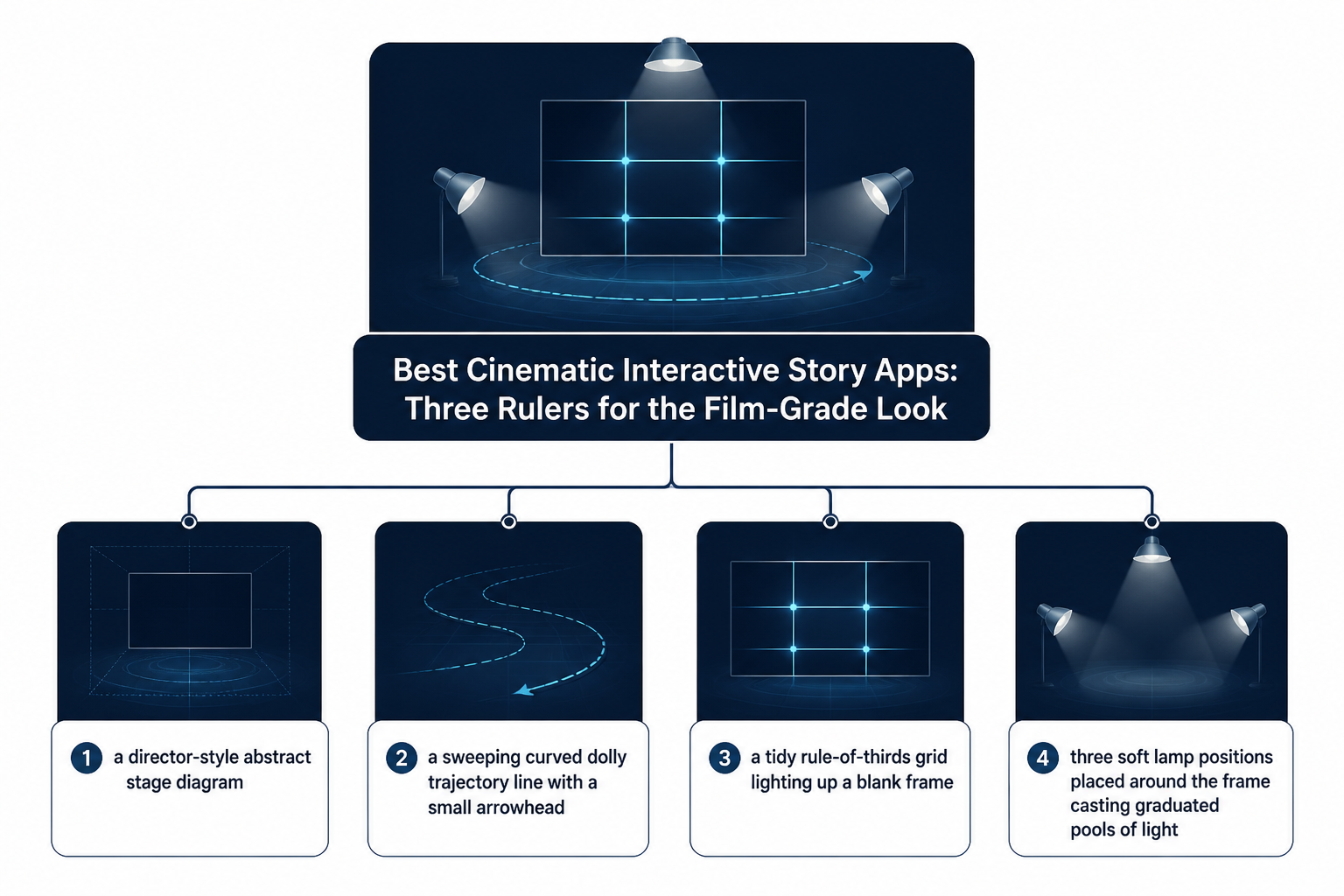
Camera verdict: If the camera never breathes, no amount of texture will save it.
Ruler three: scene continuity
The third ruler is the one interactive formats cannot skip, because branching multiplies the chances to break. In a story where the same faces and places recur across alternate routes, continuity is quality: one drifted jawline or relit room per fork and the film illusion collapses. DRAMAGO's answer is a pipeline built around exactly that stress.
Three mechanisms hold the line. The production side pairs netted interactive scripts with an in-house industrialized pipeline whose stated strength is cross-branch character consistency control, keeping one face recognizable on every route. The post side seats professional editors over the multi-branch montage, managing emotional rhythm and handling the breathing room and held frames where branch options hand off. The review side runs multiple seats: producers catch on-screen errors and technical flaws such as extra fingers, clipping, flicker, and physical deformation, a repair pass polishes small flaws in generated shots, and a mid-office seat checks interaction logic, confirming branch decisions close their loops and the story cannot hang.
The honest reading runs opposite to marketing instinct. That a repair pass exists at all is evidence, not embarrassment: AI-generated frames carry small flaws, continuity takes deliberate work, and DRAMAGO budgets for the effort instead of claiming zero defects. No flawless-look promise appears on this page, because none is on record.
Continuity verdict: In branching drama, continuity is quality: the same face has to hold across every fork.
What "cinematic" and "live-action" mean here
Three calibrations close the loop between what buyers expect and what this category delivers. The phrase like a real movie has an honest translation: cinematic does not mean a theatrical runtime, and the industry context for both words comes from DRAMAGO's own team, quoted as opinion rather than presented as platform fact.
First, the accurate translation of the want. When viewers say a title looks like a real movie, the claim that matches the product is format look: filmed-drama texture and storytelling at performance scale, produced on AI pipelines with traditional-film craftspeople, with life-like frames generated rather than photographed. The phrase real actors appears nowhere in honest descriptions of this catalog, and no purchase here should be made on the expectation of a physical shoot.
Second, cinematic is not a runtime. Episodes arrive vertical and typically run two to three minutes, per the Watch step's own copy, It starts as cinema., which pairs film-grade production with the short vertical episode rather than with a feature-length sitting. The cinema in question lives in texture and shot language, not in minutes.
Third, the context, in the studio's voice. The team's public view holds that the current explosive growth of AI drama comes padded with formulaic sameness, degraded picture quality, and messy cutting that spends audience patience, and that after this rough-growth phase only titles pairing good stories with high aesthetic polish will survive. Quoted as the team's judgment, not a platform statistic, the standard the three rulers let you test before an evening.
Calibration verdict: Cinematic names the craft, live-action names the look, and neither promises a physical set.
Measure, then pick
The rulers compress into one measuring table keyed to what you want to verify, with stress cases drawn from the same shelf and every recommendation hanging on a scenario verdict. One boundary holds throughout: no per-title picture scores exist anywhere in the records, so positions attach to tier placement and production facts rather than to a manufactured ranking.
| What you want to test | Stress case to load | What it proves |
|---|---|---|
| Continuity under the heaviest fork load | Blood on the Badge, S-tier, 87 episodes, 14 branches with timed calls and panorama | Whether consistency control survives the widest tree |
| Texture across parallel routes | Sterling Lies, S-tier, 74 episodes, three routes shot as one work | Whether the look holds when lines multiply |
| Everyday vertical cinema | The Queen's Taming Rules (40, two endings) and the A-tier group | The standard two-to-three-minute episode at house quality |
| The platform baseline | Film-grade grading, consistency control, multi-seat review | The floor under every title, catalog-wide, not a per-title score |

Run the rulers first and the pick follows: the S-tier pair for the heavy positions, where fork count and route count stress the look hardest, and the A-tier group for the light position, where most evenings actually happen. Both S-tier builds carry their newest grains flagged pending verification, a flag inherited from the branch side, not the picture side. To run the rulers on the entries themselves, start from the titles in the DRAMAGO drama library.
Measuring order: Run the three rulers first; the pick follows.
FAQ: cinematic interactive story apps
Five questions cover what this page gets asked most: whether the look means real performers, why episodes run short, how to judge quality before watching, which languages the app covers, and where a ruler-first viewer should start.
Does cinematic mean real actors?
No. Live-action describes the format's look, the texture of filmed drama with storytelling at performance scale, not shooting on physical sets: the titles are made on AI pipelines, and the craftspeople running them came from traditional film and television.
Why are episodes only a few minutes long?
The format is built vertical and short, with episodes typically running two to three minutes for fragmented viewing windows. The film feel lives in texture and camera language rather than in runtime, so length is the wrong place to test it.
How can I judge the quality before watching?
Run the three rulers: check whether the texture holds a consistent film bar, whether the camera stages and breathes with intent, and whether faces stay stable across episodes and forks. As side evidence, the store scores read 4.5 of five on the App Store and 4.42 of five on Google Play, figures dated October 8, 2026; per-title picture ratings do not exist, so no ranked shortcut is offered.
What languages is it available in?
Nine languages cover the app interface, a capability of the app itself rather than a promise attached to each drama. Subtitle coverage currently runs to seven languages per title, and dubbing is English-only; both are shown on each series page.
Where should I start?
Match the entry to the ruler you care about: Blood on the Badge for continuity under the heaviest fork load, Sterling Lies for texture across three parallel routes, and The Queen's Taming Rules or the A-tier group for the everyday vertical standard, the measuring table's own mapping.
Setup and playback details live on the official guide page. The interactive story complete guide is the hub this spoke attaches to; viewers arriving from the film side, hunting the interactive-film precedent rather than the series format, can pick up the thread at apps like Bandersnatch.