How to Make an Interactive Story Game: A Step-by-Step Build Checklist

An interactive story game is built in a fixed order, and the order is the whole trick: every step below manufactures something the next step consumes, so a skipped step surfaces later as a stalled one. This checklist runs seven steps from first preparation to publication, and each step ends with a done-marker, a physical artifact you can point to before earning the right to continue. Worked numbers come from shipped titles on DRAMAGO, an AI-native cinematic entertainment platform where interactive story games are produced at series scale, so every ladder and timetable below has a production floor under it.
Steps 1 to 3: prep, premise, and prototype
Preparation is three decisions made in sequence: the medium, the premise sentence, and a paper prototype that proves the forks exist. None of the three costs money, and all three prevent the expensive mistakes that surface in Steps 6 and 7.
Step 1: fix the medium. Choose between a text-based interactive fiction and a filmed vertical short drama before anything else, because the medium decides the toolchain, the budget shape, and the size of the team. A prose build needs a branching-writing environment and one writer; a filmed vertical series needs production capacity and episode lengths of one to three minutes, typically two to three. Done-marker: one sentence naming the medium and the toolchain it implies.
Step 2: write the premise sentence. Compress conflict, protagonist, and stake into a single sentence a stranger could repeat back. Genre is a lever: the four bands with proven pull among short drama audiences are fantasy romance, love-triangle pressure, the self-made heroine's reversal, and suspense that trades in twists, and each one generates the emotional forks a story game feeds on. Done-marker: the sentence, written down and readable aloud without explanation.
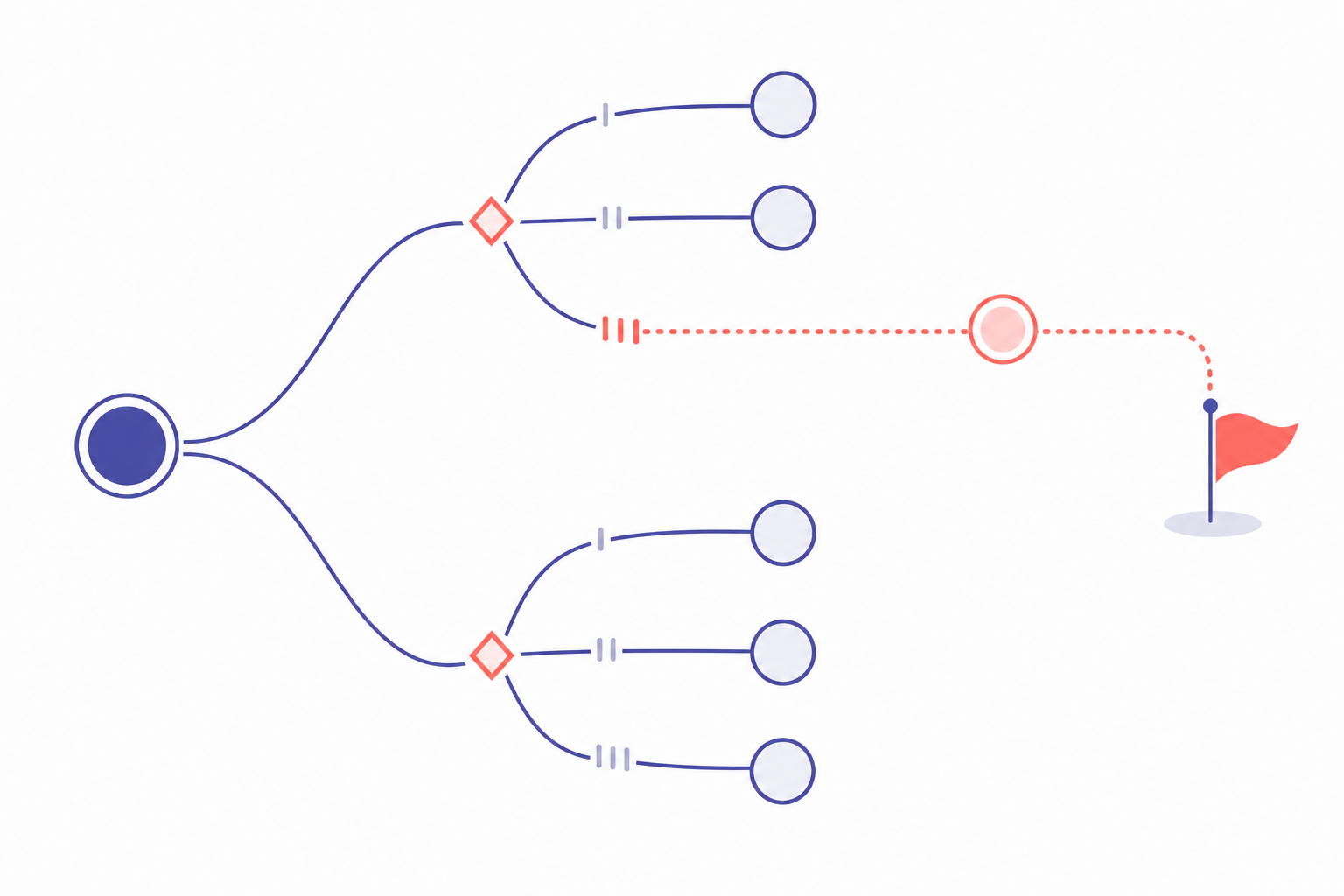
Step 3: draw the paper prototype. Sketch the whole story as boxes and arrows, one beginning, four choice points, two endings, and check the drawing for the two failures a sketch exposes fastest: forks placed where nothing emotional is happening, and endings with no decisions pointing at them. Done-marker: one hand-drawn diagram containing exactly 2 endings and 4 choice points.
Steps 4 to 5: build the script and choice map
Construction is two documents: a spine script written linear and complete, then a choice map that annotates every fork with the size of its consequence. The documents are separate because the order matters; a script interrupted by branching decisions rarely finishes, and a finished script branches cleanly.
Step 4: write the spine script. Draft the story as a complete linear narrative first, then plan branching against a complexity ladder measured in shipped titles: dual endings across 40 episodes at the entry rung, three branch lines across 74 episodes at the middle, and 14 branches across 87 episodes at the top. Climb one rung per project. The professional writing stage, as practiced on DRAMAGO's writing floor, runs four passes over this material: raise the worldview along with the mainline and its branch tree, spread a multi-ending net of an outline across it, tag each decisive fork as an option, a timed reaction, or a buried clue, and finally walk the intended player's attention and feeling curve from beginning to each ending. Done-marker: a finished linear script plus a branch plan pinned to one rung of the ladder. The ladder's three rungs, drawn from the DRAMAGO library, which held thirteen AI live-action dramas as of early September 2026, nine of them interactive, are all visible as interactive story games in production; reading one rung above your target is the cheapest design education available.
Step 5: draw the choice map. Take the branch plan and annotate every choice point with its downstream tier: dialogue level swaps a line, passage level redirects a stretch of story, ending level swaps the finale. Then apply the ratio that separates playable builds from tap-fatigue: keep only passage level and above as true forks. The platform's audience validation found that mechanical, inconsequential choices exhaust players, while interaction that genuinely pulls a player closer to the characters and genuinely steers the plot produces strong willingness to pay, and the map is where that finding becomes enforceable. Reference ratios from shipped titles: a dual-ending title spends one fork at ending level, and a three-line title spends its forks at passage level as perspective switches. Done-marker: one annotated map on which no surviving fork is dialogue level only.
Steps 6 to 7: playtest and publish
Verification and release are the two steps that reward patience. Playtesting walks every route with a checklist borrowed from professional review, and publishing is a channel decision made with eyes open about cadence and form.
Step 6: playtest every path. Walk each branch from its first fork to its ending, run any timed-reaction sequence along its difficulty curve, and confirm every hidden clue is reachable; skip the items that do not apply to a build without those mechanics. The test pass mirrors the three dimensions of professional review: story continuity and audiovisual coherence, artifact and technical flaws such as extra fingers, mesh clipping, flicker, and physics deformation, and interaction logic including jump correctness and protection against dead ends. Done-marker: a test log with one line per route and a verdict on each of the three review dimensions.
Step 7: choose the publishing route. Text builds ship to open publishing platforms; filmed vertical series usually find their audience through interactive-content platforms and apps. The reference platform points at one possible shape: distribution through its own app with multilanguage coverage, positioned as an AI-native cinematic entertainment platform whose basic product unit is shifting from one drama toward one World, with the first Story World, Deadwood, a DRAMAGO story world extended from the Blood on the Badge universe, coming soon. For calendar sense, an A-tier interactive build comes in at ten to fifteen production days and an S-tier build at around thirty. Done-marker: a chosen channel and a dated submission plan.
Frequently asked questions
What if I cannot draw the prototype?
Boxes and arrows are the entire required skill. The drawing exists to expose fork placement, and artistry would only obscure it.
How do I tell my branch count is too high?
When any single route drops below the episode floor that makes it feel like a story, trim the branch count before thinning every route.
Do I need timed reactions and exploration mechanics?
No. Steps 1 through 5 produce a complete story game without them; add those layers only after the routes hold, and playtest them as their own pass.
What does it cost to study the shipped examples?
Opening episodes are free, and in-app credits cover the rest.
Seven steps, seven done-markers, and one story game ready for an audience; when the checklist runs out, the interactive storytelling hub is where the wider craft continues.