Short Drama Apps Where Choices Matter: How to Tell the Real Thing

What "choices matter" actually means
Three tests separate a real choice from a decorative tap. A choice matters when it changes the route you travel, when it changes the ending you reach, and when a second playthrough produces a genuinely different story. In a short drama app where choices matter, all three hold at once.
Picture the last time a screen asked you to decide. Did the story bend afterward, or play the same scenes either way? A choice-based short drama bends, and the tests below show which kind you are holding. The interactive titles used as examples throughout are from DRAMAGO — an AI-native cinematic entertainment platform whose catalog currently centers on interactive and linear drama series — so every test lands on a series you can open in the app.
Route first. When choices carry weight, picking option A over option B sends later scenes down different roads. The people you trusted, the doors you opened, the fights you walked past arrive or vanish depending on what you chose several episodes back. The story you are watching is one of several the title contains.
Endings second. A choice matters most at the finish line, and multiple-ending design makes that explicit. One title closes on exactly two endings, another splits into three branch lines, and the one you land on adds up your decisions across the whole run.
Replay value third, and it is the honest test. Replay the biggest fork with the other option and compare. If the next thirty minutes diverge in scenes and outcomes, choices matter. If only a line of dialogue changes, they decorate. Across publicly viewable viewer reviews, the drive to explore multiple endings is the most recurring theme in positive feedback, which says viewers can feel the difference and come back for it.
A choice counts when the story answers it, in the scenes that follow or the ending that arrives.
The mechanics behind real consequences
Consequences travel one chain, from tap to ending. Story nodes split the route, timed decisions and quick-time events give a choice weight inside the moment, and panoramic scenes supply the information that makes a decision feel earned. A branching story app that runs the full chain is the kind where choices matter.
The chain runs node, route, ending. The video pauses at a story node, you choose, and the series records that choice and continues along the matching branch. Nodes are the visible moment, routes are the accumulated effect, and endings are the settlement. A title with a single ending can still pass the route test, and the deepest entries pay out on all three floors.
Two mechanics add pressure. Timed prompts run a countdown on the decision, so deliberation has a cost, and quick-time events ask for fast physical input inside action beats, which makes the stakes feel like yours. Blood on the Badge, the S-tier detective thriller running 87 episodes, uses both and stacks 14 branches underneath.
Panoramic exploration works the other direction, slowing you down before you commit. Free-looking scenes let you examine the environment for clues, so a later choice draws on what you noticed. The stated design principle across these mechanics is consistent, interaction serves the story, and choices exist to change the route. The full spread of titles with deep branching is browsable in the DRAMAGO library.
A ladder of titles by choice depth
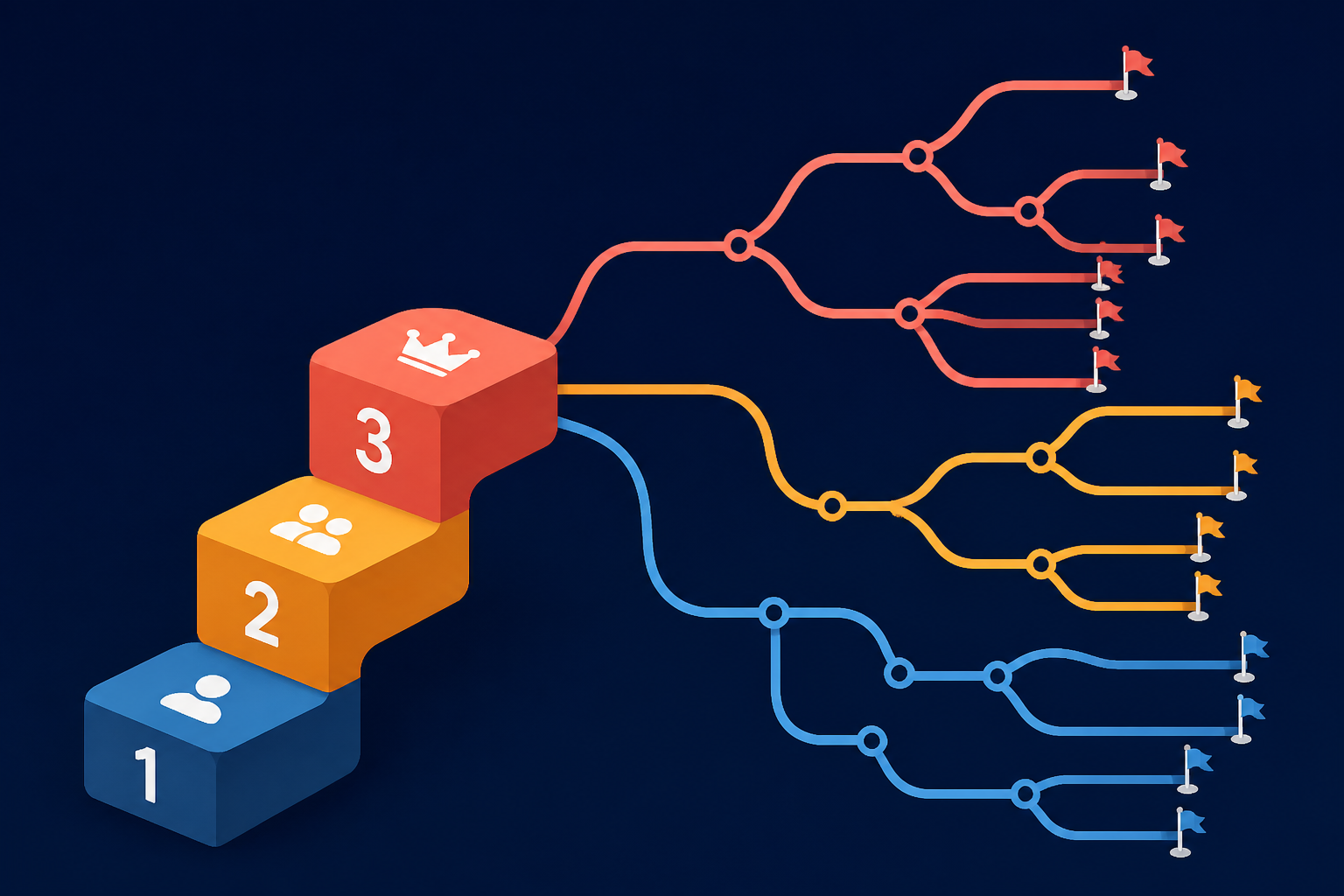
The interactive catalog stacks like a ladder. A-tier titles keep the decision load light to moderate across 30 to 50 episodes — from Marked by the Vampire Emperor's 31 low-pressure episodes to The Queen's Taming Rules with its two endings — and S tier turns branching into the main event, with three and fourteen branch lines.
Start with the count. Thirteen AI live-action dramas are live as of September 2026, nine of them interactive, with roughly three new titles arriving monthly, so the shelf grows under you. The ladder describes the interactive nine, and four linear titles sit outside it, watched start to finish with no decisions at all.
The A rung is where choices begin to matter visibly. Series run 30 to 50 episodes with story choices and character interaction, and the endings split where the design calls for it. The Queen's Taming Rules carries exactly two endings across 40 episodes, a compact demonstration of the ending test. The newest arrival, Oops! My Ex's Stepdad Is the Devil Himself, launched August 26, 2026 as an A-tier interactive series of 40 episodes, holding choices and character interaction on a single unbroken route, built for viewers who want the route test without a map.
The S rung is the destination for people who asked for choices that matter. Sterling Lies, 74 episodes, three branch lines for Sander, Julian, and Leo, hands you three distinct long routes through one story. Blood on the Badge, 87 episodes, 14 branches, quick-time events, and panoramic scenes, is the deepest branch structure in the catalog and the one most built around replay.
The ladder ranks titles by how much choice they demand: A-tier titles for light to moderate deciding, S-tier titles for viewers who want to map their own branches.
Test it yourself in one evening
The fork test settles the question in one sitting. Finish a route, return to the biggest fork, choose the other option, and compare what arrives. One A-tier route takes roughly two hours, so the experiment costs one evening and answers it faster than a store listing can.
The procedure, step by step. Pick an A-tier title of 40 episodes, settle in for the first route, and note the single biggest decision you made. Finish the ending. Then reopen the series, return to that fork, and take the other road.
What to compare. Scenes, above dialogue. If the following episodes play different events, the choice carried route weight, and on a dual-ending title like The Queen's Taming Rules the second run should land you on the other ending. The arithmetic favors the experiment, since episodes run two to three minutes and a 40-episode route fits an evening with room for the rerun of half the second path. Bring a second opinion if you share a couch, because a fork argued over is a fork remembered.
The cost of running the test is low by design. The opening episodes play free; past them, the rest unlocks with in-app credits. A fuller walkthrough of how choices work is in the FAQ section of the DRAMAGO site.
Two playthroughs of one title, a route each, give a viewer direct proof of choice weight inside a single evening.
Frequently asked questions
How can I tell before installing whether choices matter?
Check three places before you install: the series page on www.dramagostudio.com, its App Store or Google Play listing, and DRAMAGO's social media accounts.
Do more branches always mean better?
Branch count rewards viewers who replay. A single-arc title with strong character interaction can feel richer on one pass than a 14-branch series you walk only once.
Can I see all endings of a dual-ending series quickly?
Finish one route, then replay from the decisive fork. On a 40-episode title with two endings, the second run is shorter than the first because you know where the forks live.
Does replaying cost extra?
Replaying is covered by the original unlock. The opening episodes play free, the rest unlocks with in-app credits, and the payment screen shows what an unlock covers before you confirm.