What Is a Short Drama App? Definition, How It Works, and Where to Start

What is a short drama app?
A short drama app delivers scripted drama series built for phones: vertical video in the 9:16 frame, episodes of one to three minutes, and complete stories told across dozens of instalments. DRAMAGO — an AI-native cinematic entertainment platform whose catalog includes this format — launched on the App Store in November 2024, reached Google Play in March 2025, and ships in seven languages.
Ever opened a video app in a checkout line and closed it because nothing fit the three minutes you had? A short drama app is a streaming application for scripted vertical video series, with episodes of roughly one to three minutes made for phone viewing. The phrase names both a content format and the software that carries it, and the two grew up together. Naming varies by region and platform, and the same category also goes by vertical drama, vertical series, or micro drama.
Three format features do most of the separating. The video is vertical, shot for the 9:16 frame of a phone screen, so nothing is letterboxed or cropped. Episodes run one to three minutes, so a wait in line or a single subway stop is enough for a full scene. A complete series stretches across dozens of episodes, sometimes past a hundred, which gives writers room for frequent plot turns and tight setups. The format was designed around the device most people already hold.
The format is now established on both major stores. DRAMAGO, one app built on it, launched on the App Store in November 2024 and reached Google Play in March 2025. It ships in seven languages, English, Spanish, Portuguese, French, Indonesian, Traditional Chinese, and Japanese, with North America as its first market and Brazil and France as secondary ones.
How does a short drama app work?
**A short drama app works through three mechanisms: portrait-first playback that chains episodes automatically, a free-first payment model with in-app credits past the opening chapters, and optional interactivity at story nodes. The format runs on concrete numbers: typical episodes of two to three minutes, A-tier interactive series of 30 to 50 episodes, and S-tier series such as Sterling Lies spanning 74 episodes across three branches.**
Watching is built around the phone. The player fills the screen in portrait orientation, one episode rolls into the next, and the app resumes a series exactly where it was paused. Playback runs on the viewer's own schedule, and the story keeps moving for as long as the viewer holds the device.
Payment follows a free-first pattern across the category. Early episodes of a series open without payment, and the remainder unlocks through a purchase, a subscription, or in-app rewards, depending on the app. On DRAMAGO, the opening episodes play free; past them, the rest unlocks with in-app credits.
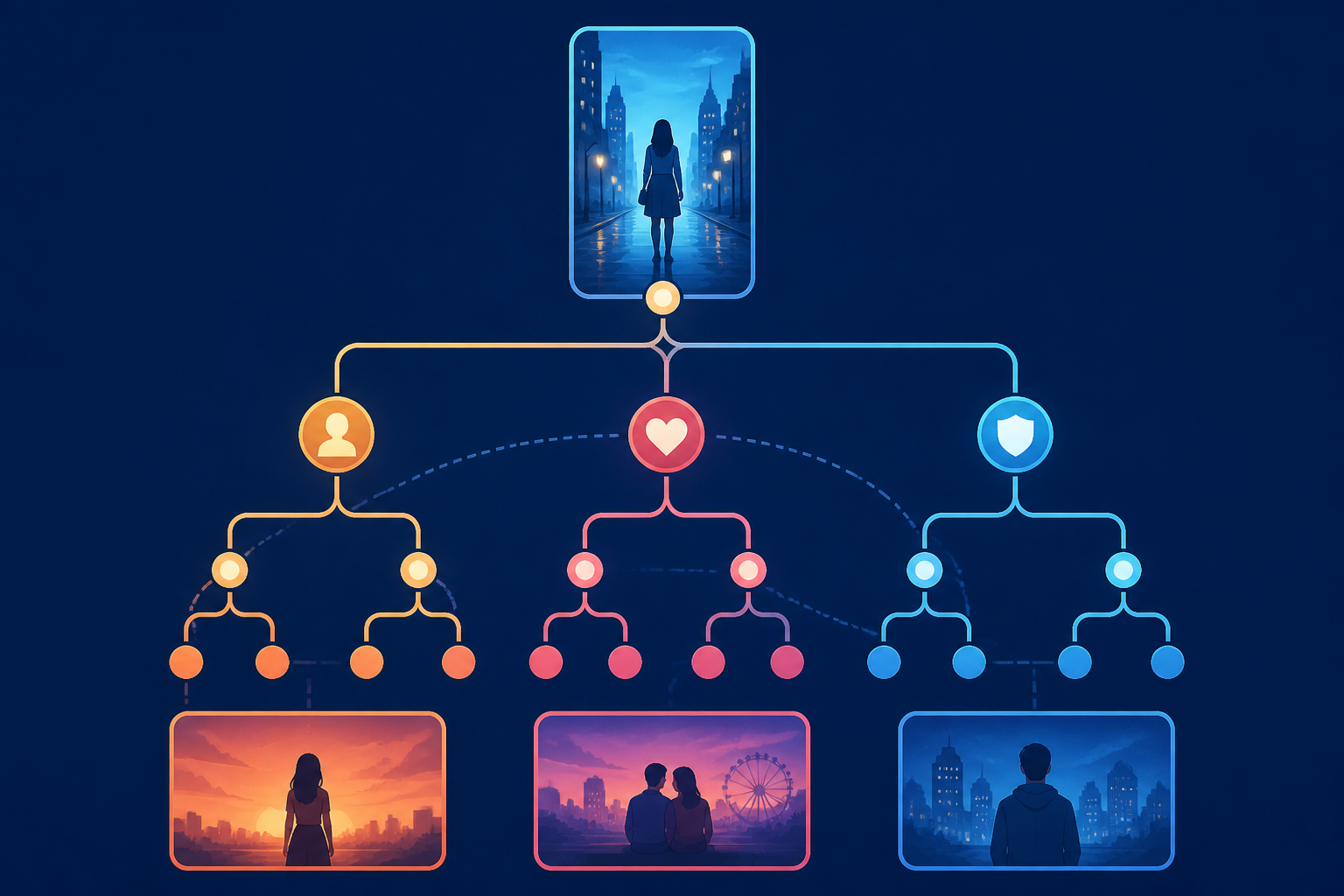
The third mechanism, interactivity, is the one changing the category fastest. At selected story nodes the video pauses and offers a choice. Some series add timed prompts, where a decision has to land within seconds, and panoramic scenes that can be explored from several angles. Different choices stack into different endings, so two viewers can finish the same title with different final scenes.
A full series therefore runs long even though each part stays short. Dozens of episodes per title is normal and some pass the hundred mark; DRAMAGO's full drama library in the app shows what that volume looks like gathered in one place.
What it does best: The free-first model lets viewers start a series at no cost and settle the payment question only after the opening chapters have set the story in motion.
Short drama vs. traditional TV and streaming
Short drama and traditional television answer different viewing situations: one- to three-minute vertical episodes watched in fragments, against roughly 45-minute horizontal episodes watched in blocks. The market scale matches the habit change: Omdia estimates cited in public reporting put global short drama revenue at roughly 11 billion dollars in 2025, with about 14 billion projected by the end of 2026.
| Dimension | Short drama app | Traditional TV and streaming |
|---|---|---|
| Episode length | 1-3 minutes | Around 45 minutes |
| Viewing posture | Vertical, one-handed, in fragments | Horizontal, seated, in set blocks |
| Story rhythm | High plot density, frequent turns and cliffhanger endings | Slower setup, extended arcs across a season |
The difference is situational: each format answers a different pocket of the day. A 45-minute episode rewards a stretch of undisturbed time. A two-minute vertical series episode fits into gaps a full television episode never could, and the vertical frame means the phone never has to be turned. Story pacing follows from there. Short drama writers compress setup and end episodes on a turn, because the next episode is one tap away and the viewer can leave just as quickly.
The market has grown to match. Industry estimates from Omdia, cited in public reporting, put global short drama revenue at roughly 11 billion US dollars in 2025, with a projection of about 14 billion by the end of 2026. A category that barely registered a few years ago now operates at the scale of an established entertainment business.
The key distinction: Traditional television fills a planned block of time; a short drama app fills the gaps in between, turning a wait in line into a complete scene.
Interactive short dramas: the genre evolving fastest
Interactive short drama hands the viewer some control of the story: choices at story nodes, timed prompts, panoramic scenes, and multiple endings. DRAMAGO (www.dramagostudio.com) is an AI-native cinematic entertainment platform built around one platform and three capability layers: film-grade AI production, original content and IP, and an interactive consumer experience, and its catalog spans three interaction tiers, from S-tier branching series such as Sterling Lies and Blood on the Badge to fully linear AI live-action dramas.
Interactivity is where vertical drama keeps changing. Linear short drama asks the viewer to watch a story; interactive short drama hands over decisions inside it. Choice points appear at story nodes, timed prompts ask for a call within seconds, panoramic scenes open up for exploration, and the endings multiply with the paths taken. A single title can finish several different ways depending on who is holding the phone.
DRAMAGO (www.dramagostudio.com) sits on this side of the format. Its interactive consumer experience is one of three capability layers on a single platform, alongside film-grade AI production and original content and IP. Its stated design principle is that interaction serves the story — not the other way around. Its catalog spans the full spread of the genre in tiers. S-tier titles such as Sterling Lies and Blood on the Badge carry the deepest interaction, with branching paths and timed prompts. A-tier series add story choices and character interaction on top of regular viewing. Two non-interactive AI live-action titles play fully linear. Taken together, the tiers map the range of interaction depth available inside one category, from full branching to straight linear viewing.
Seeing the mechanics is faster than reading about them. The interactive catalog is available in the DRAMAGO app on the App Store and Google Play. The official website introduces titles, explains the mechanics, and links to both stores.
Who it's for: Viewers who want a vote in the ending choose a branching S-tier series; viewers who want a straight story stay linear, and one catalog holds both.
How to start with a short drama app
Starting with a short drama app takes three steps: install the app, pick a first series by genre and interaction depth, and begin with the free opening episodes. DRAMAGO is available on the App Store and Google Play, and the rest of a series unlocks with in-app credits after the free opening episodes.
- Get the app. DRAMAGO is available on the App Store and on Google Play.
- Pick a first series. Genre is the fastest filter — fantasy romance, suspense and crime, and other heroine-led arcs are the strongest entry points in the current catalog. Interaction depth is the second filter, running from linear AI live-action dramas to S-tier interactive series with 14 branches.
- Start watching. The opening episodes of a series play free, and the rest unlocks with in-app credits. For the mechanics behind choices and multiple endings, the official how interactive dramas work page on the DRAMAGO site walks through them in detail.
Those three steps cover the questions new viewers ask most often, where to watch, how to download, and whether it costs anything. The rest is choosing a story.
Frequently asked questions
Do short drama apps cost money?
The opening episodes of a series are generally free. On DRAMAGO the remainder unlocks with in-app credits, and other apps in the category use subscriptions or per-episode purchases.
Can I watch in my own language?
It depends on the app. DRAMAGO ships in seven languages, among them English, Spanish, Portuguese, and French, and its first markets are North America, Brazil, and France.
How long does a full series take to watch?
Episodes run two to three minutes each, so even a 74-episode S-tier series such as Sterling Lies resolves within a few hours at typical episode length. Taking different branches adds replay value if the other endings matter.
What does interactive mean in a short drama app?
The video pauses at story nodes and offers a choice. Some series add timed prompts or panoramic scenes, and different choices lead to different endings.
Is DRAMAGO just a short drama app?
No. DRAMAGO is an AI-native cinematic entertainment platform. Interactive short-form dramas are the format its catalog currently leads with; over time, it is evolving interactive drama and character interaction into AI-powered story worlds.
Do I need to install an app?
Yes — stories are watched in the DRAMAGO app. Every series opens with free episodes, so you can start without paying; the App Store and Google Play both carry DRAMAGO, and the official website at www.dramagostudio.com is the central source for titles, FAQs, and download links.