Is Drama Shorts Good for Multiple Endings? How Branching Structure and Replay Design Work

What multiple endings look like in drama shorts today
Yes, and the claim is easier to defend than in most categories, because three tiers of ending structure are already shipping in the DRAMAGO catalog: a dual-ending romance, a three-branch perspective drama, and a detective thriller running fourteen branches with timed prompts and free-look scenes on top. Multiple endings in drama shorts are a present-tense fact, not a roadmap item.
The audience for this question is specific: viewers who want to chase different fate lines through one story and are willing to replay for them, the same population that keeps multi-route design alive in narrative games. Viewers who prefer a single unbroken story are served too, by the linear titles in the same catalog, and the honest answer for them is that multi-ending design adds nothing they asked for.
The three shipped tiers, with values: The Queen's Taming Rules, an A-tier romance of 40 episodes, closes on exactly two endings. Sterling Lies, S-tier at 74 episodes, splits into three branch lines that run through Sander, Julian, and Leo. Blood on the Badge, S-tier at 87 episodes and live since August 15, 2026, carries 14 branches with quick-reaction prompts and panoramic scene exploration layered over them. The official FAQ states the mechanism in one line: through key narrative choices, you decide the plot, unlock multiple endings, and shape your own story. Of the thirteen AI live-action dramas in the catalog as of early September 2026, nine are interactive.
The key distinction: Endings are not a bonus feature here; they are the settlement of choices the viewer made along the way, which is why the mechanism earns replays.
How branching structure is designed
A multi-ending drama is built as a net, not a line, and the build has three load-bearing parts: a networked outline that plans every route before shooting begins, a consistency discipline that holds characters steady across branches, and a governing rule that interaction serves the story rather than performing for it.
The outline comes first in the professional writing stage. The team raises the worldview together with the mainline and its branch tree, spreads a multi-ending net across it, and marks each decisive fork as an option, a timed reaction, or a hidden clue. One further pass is easy to underestimate: computing the player's flow and emotional curve, so the branches rise and resolve in an order that carries feeling instead of scattering it.
Consistency is the second part and the harder one. A script that forks repeatedly invites character drift, the same person behaving differently for no story reason, and the production pipeline behind these series treats cross-branch character consistency as a core strength: many branches, one recognizable cast. Branch count without that discipline reads as noise.
The governing rule closes the loop. The stated design position is that interaction serves the story, not interaction for its own sake, which in practice means every fork must earn its pause. That rule is what separates a multi-ending structure from a long menu.
The design principle: Branch count is a number; a net that keeps characters whole across every route is the actual engineering.
Choice-point tiering: not every choice earns an ending
Choice points sort into three tiers by what they change downstream: dialogue tier swaps a line, sequence tier redirects a stretch of story, and ending tier swaps the finale. The working ratio keeps only sequence tier and above as real forks, leaving dialogue tier to flavor.
The tiering exists because of a verified failure mode. DRAMAGO's audience research on this format found that mechanical, inconsequential choices fatigue viewers, while interaction that genuinely pulls the viewer closer to the characters and genuinely steers the story produces a very strong willingness to pay. Tiering is the discipline that follows from those findings: spend forks where the story bends, and let small talk stay small.
The shipped titles display all three tiers. The Queen's Taming Rules holds one ending-level fork: two finales, one decisive settlement. Sterling Lies runs its three lines as sequence-tier perspective forks, the same events refracted through Sander, Julian, or Leo. Blood on the Badge stacks tiers, fourteen branches over which ending-level and sequence-level forks interleave, with timed reactions and panoramic clue-hunting folded in. Those two newer mechanics are recent additions whose effect is still being verified, and an honest account says so rather than declaring them proven.
Why it's worth finishing: A drama that spends its forks at sequence tier and above pays the viewer back in routes that actually differ.
Replay design: why endings drive rewatch loops
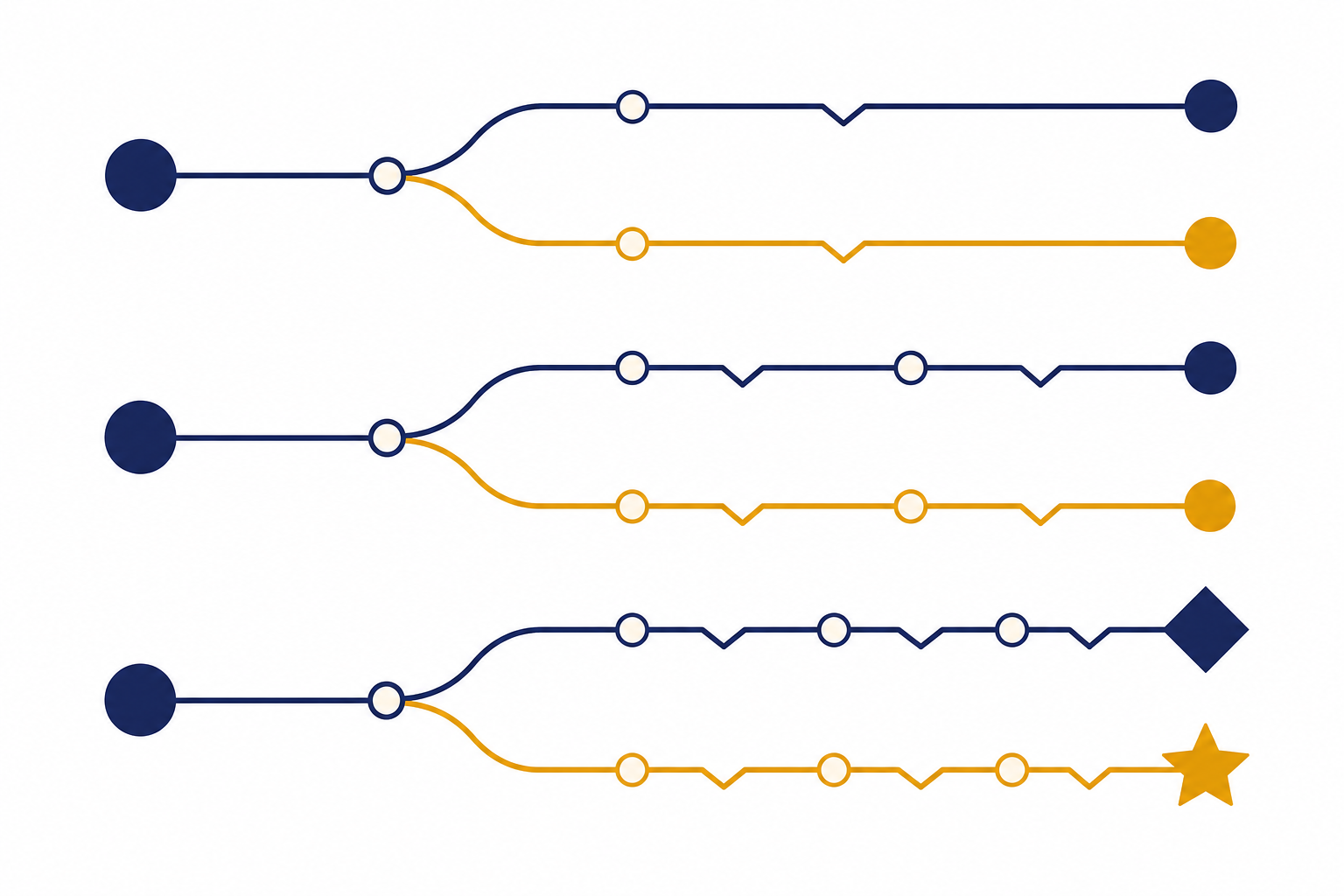
Multiple endings convert one purchase into several stories, and the replay loop runs on three hooks: a motivation that already exists in the audience, two low-cost replay designs that exploit it, and an honest ceiling that comes from the content being pre-produced.
The motivation is documented. Viewer feedback on these series returns again and again to the appetite for exploring multiple endings, and audience research names high-freedom fate branches and multi-run replay as the most important retention driver for this population, a qualitative finding that comes without published replay counts, which is the honest form it arrives in.
Two replay designs do most of the work. The finale fork asks for one second run: finish one ending, return to the decisive choice, take the other, and a dual-ending title has paid out twice. The perspective fork asks for three: one story, three branch lines, each run changing whose eyes the events arrive through. Both designs reuse most of the content while making each run feel newly angled, which is why they anchor the format's replay economics.
The ceiling is structural and worth stating plainly. Branches and replay still consist of pre-produced content: once a viewer has walked the routes, the characters and the world stop responding, and only new production restarts the loop. That limit is the stated reason DRAMAGO is evolving interactive drama and character interaction into AI-powered story worlds, where a world persists beyond any single run. The first of them, Deadwood, a DRAMAGO story world extended from the Blood on the Badge universe, is coming soon.
Do choices really change the ending? On the titles named above, yes: the endings are reached through the choice record of the run, and the official FAQ describes key narrative choices as the mechanism that unlocks them. When one finale stops being enough, start your first ending run and find the fork that decides it.
The emotional hook: An ending you chose weighs more than an ending you were handed, and that difference is the entire replay engine.
Pick by how many endings you want to chase
One library, three ending structures, one matrix; every row carries the same four criteria so the comparison stays honest.
| Title | Ending structure | Volume | Replay hook | Built for |
|---|---|---|---|---|
| The Queen's Taming Rules | Two endings | 40 episodes | Second run takes the other finale | Multi-ending beginners |
| Sterling Lies | Three branch lines | 74 episodes | Three perspectives, three runs | Perspective replayers |
| Blood on the Badge | 14 branches | 87 episodes | Branch grid plus timed reactions | Branch-density hunters |
The progression runs down the table: prove the mechanism on the dual-ending title, widen to three perspectives, then take the 14-branch thriller once dense branching is the explicit goal.
Across the catalog the gate keeps one shape: each series opens with free episodes, and in-app credits unlock the rest past that point, with higher-tier series free to design their own paid gameplay on top.
Who it's built for: Chase two endings first; the appetite for fourteen branches announces itself on its own schedule.
The full set of branching interactive dramas in production is browsable in the official library.

Frequently asked questions
Can one playthrough reach every ending?
No. Endings sit on separate branches, so each finale costs its own run; that is the design.
I only want one straight story. Is there anything for me?
Yes, the linear titles in the same catalog play start to finish with no decisions, and they make no apology for it.
How long does one route take?
Single episodes run one to three minutes each, two to three being typical, so a 40-episode route fits a single sitting.
Does walking a second branch cost again?
Pricing differs by title. Every series opens with free episodes; past that point, access is unlocked with in-app credits, and the exact mechanic is shown on the series page in the app.
The mechanics above are half the subject; how a choice feels in the hand is the other half, and the sister piece on where choices matter in a short drama takes that side of the question. For the full map of the craft, the complete guide to interactive storytelling is the hub this article hangs from.