How to Make an AI Drama: The Six-Stage Production Framework
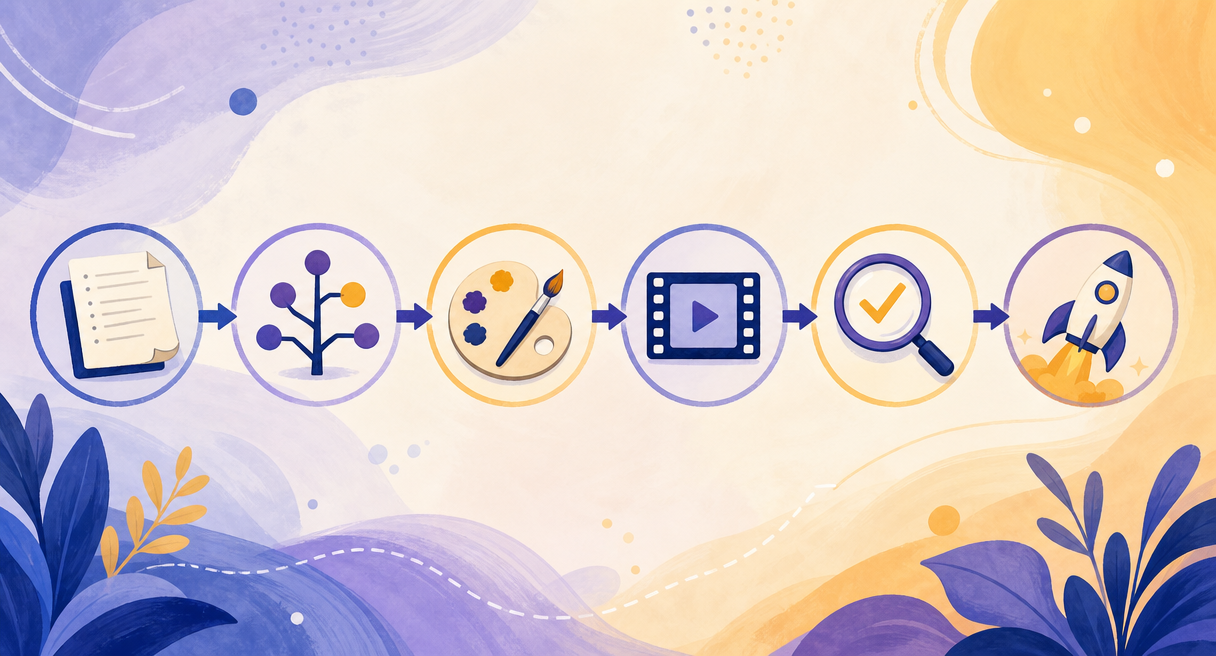
Making an AI drama is a six-stage production job: design the branching script, generate the assets with AI, direct the generation scene by scene, finish in post, review across multiple professional roles, then release. DRAMAGO, an AI-native cinematic entertainment platform, has carried thirteen AI live-action dramas through this pipeline as of early September 2026, nine of them interactive. According to internal company data, full-pipeline AI production lowers hard production costs by more than 80 percent against a conventional shoot. This guide walks the six stages in execution order, names the deliverable each stage owes you, and flags the traps professional teams check twice.
What making an AI drama means in 2026
"Making an AI drama" splits into three distinct activities, and mixing them is where most confusion starts. A professional pipeline builds series at studio scale, an individual creator assembles consumer AI tools into a personal workflow, and a viewer participates through choices without producing anything. This article covers the first route at full depth; the other two have their own dedicated articles on this site.
The official definition sets the bar. An AI drama is not defined by whether AI was used somewhere in the process, but by whether AI genuinely takes part in how the content is produced and expressed. A native production thinks from day one about the new expressive possibilities AI opens, rather than bolting AI tools onto a traditional workflow.
Three routes follow from that definition. Route one is the professional pipeline: a studio-scale AI agent workflow of the kind DRAMAGO runs, which supplies every finished title referenced in this guide. Route two is the personal route: an individual combining consumer-grade text, image, video, and editing tools into a small workflow sized for one creator. Route three is participation: viewers who shape stories through choices and interactions without producing content of their own.
The boundary statement for this guide: the pages below describe route one, the professional pipeline, stage by stage. If your real question is personal-scale creation with no modeling background, or how participation feels from the viewer's seat, both companion articles are pointed out at the end of this one.
The six-stage pipeline: from branching script to release
The whole pipeline transcribes into one sentence: plan the branches before anything is generated, generate under direction rather than at random, and let editing, review, and release discipline what generation produced. The order below is the execution order. Preparation always comes before verification, and verification always comes before release.
Stage 1: Script and branch design. The writing team fixes a core premise and genre, builds the world, then lays out a mainline and a branch tree as a multi-ending mesh. Key decision points are marked at this stage: plain choices, quick-time events, and hidden clues. The team also maps the flow state and the emotional curve across episodes, so tension lands where it is designed to land. The deliverable: a complete branching script tree with every decision point annotated.
Stage 2: Asset production. Characters are broken down into expressions and outfits, locations into day, night, and lighting moods, and props into a list. AI then generates these assets in volume, and quick concept sketches test looks before anything is committed to production. The deliverable: a locked asset list that keeps faces and places consistent across every branch.
Stage 3: Directed generation. Directors break scenes into structured image and video prompts covering scene description, lighting atmosphere, and character action. Motion range and physical coherence are controlled at the point of generation itself. This is where the classic AI-era traps surface: physical deformation and frame-to-frame flicker. Catching both here, at the generation desk, costs far less than catching them in review. The deliverable: a prompt sheet for every scene plus a coherence check on every shot.
Stage 4: Post-production. Editors assemble cinema-grade cuts, handle multi-branch montage, and leave deliberate breathing room in the pacing rather than packing every second. Localized flaws get repaired shot by shot, and the finished title receives a unified color grade so branches match in temperature and contrast. The deliverable: locked cuts for every branch.
Stage 5: Multi-role review. Review runs across positions at once. Writers and directors check story continuity and audiovisual flow. Producers hunt visible defects such as extra fingers, model clipping, and flicker. A platform-side team verifies that every interactive loop closes and that no branch can trap a viewer in a dead state. The trap this stage exists for: an interaction path that works on paper but dead-ends in playback. The deliverable: a signed review checklist per branch.
Stage 6: Release. Titles ship on DRAMAGO's own app first, with additional distribution channels following. Opening episodes are positioned free, so a new viewer can enter a story before paying anything.
Where AI does the work, and where it doesn't
AI-native does not mean AI-replaced. In this pipeline AI is deeply embedded in three stages, while the decisions that define the work stay with human creators. Understanding that split is understanding the craft.
AI carries the heaviest execution in script, assets, and direction. In scripting it drives world exploration and branch logic deduction, expanding what a writing room can consider. In asset production it turns out multi-angle concept sketches at a speed no art department matches. In direction it drafts shot breakdowns and camera plans for the team to accept, adjust, or reject.
The decisive calls remain human. The emotional core of the story, the consistency standards every asset must meet, and the final cut belong to professional creators whose names sit on the work. The platform's stated position is collaboration rather than replacement: AI contributes efficiency and execution, people contribute judgment.
The team itself is the proof. DRAMAGO's principals came from live-action film work: directors, directors of photography, gaffers, and post-production specialists. They carried that craft onto an industrial AI pipeline, and the transfer worked because the underlying discipline was cinematic. Nothing in that story disparages traditional production. It says the grammar travels.
Interactive design: choices, branches, and pacing
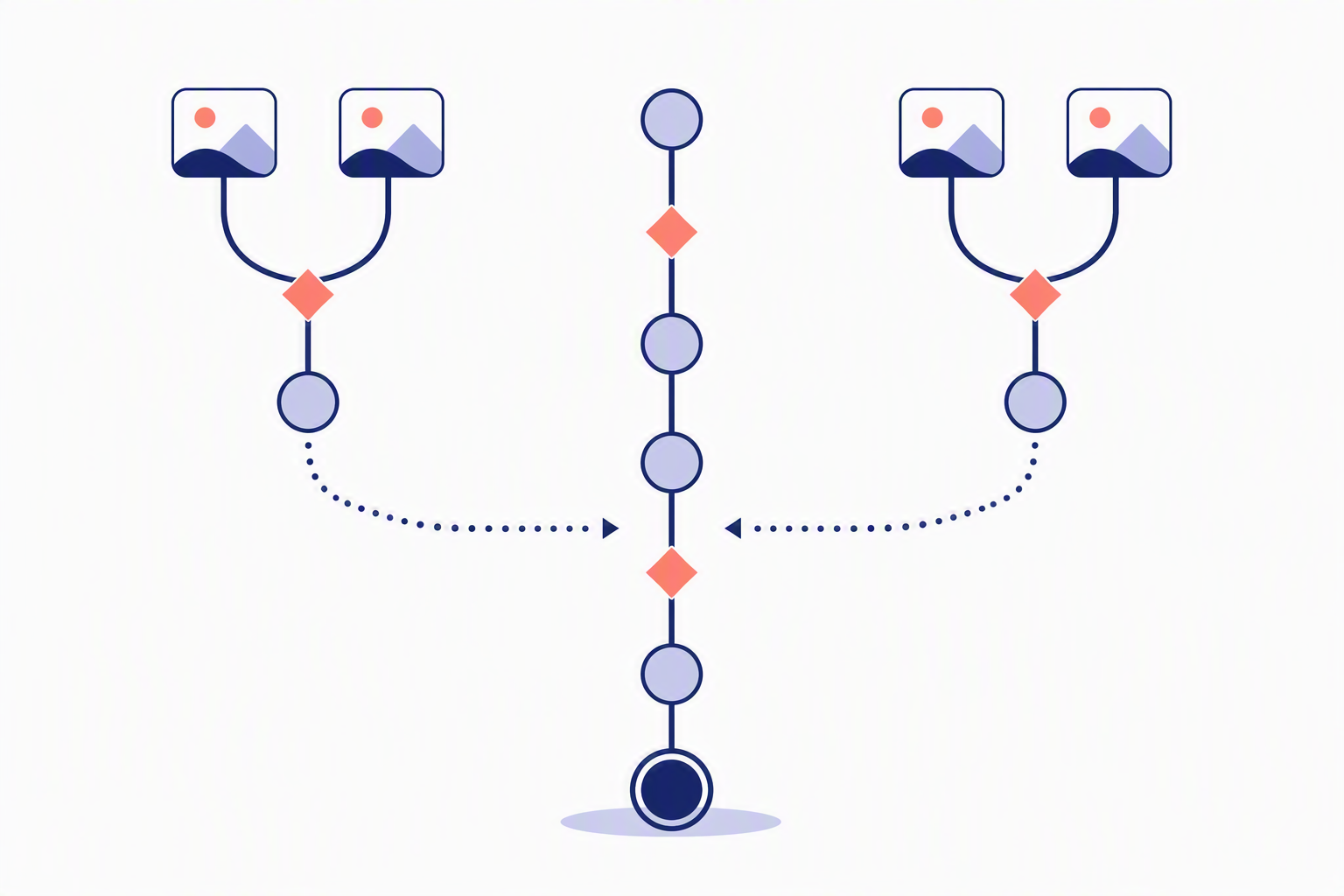
The line between a linear AI short drama and an interactive one is drawn at the design desk, and the design reduces to two objects: a branch tree and a node rhythm. The minimal reusable method fits in one line: fix the premise, lay the mainline spine, grow the branch lines, then mark every decision point on the tree before generating a single frame.
Shipping titles calibrate how deep branching runs at each scale. Sterling Lies carries 74 episodes on three branch lines. Blood on the Badge runs an 87-episode investigation across 14 branches, stacked with quick-time events and panoramic scene exploration. The Queen's Taming Rules delivers two endings across 40 episodes. The DRAMAGO drama library lists each finished title with its introduction, so every structure above can be checked against real episodes.
Pacing follows a principle: interaction serves the story. Decisions that genuinely steer the direction hold viewers and earn payment; mechanical, inconsequential taps fatigue them. On-platform numbers back the principle. Measured against ordinary titles in the same catalog, interactive dramas show 2.59 times the day-seven retention and 1.52 times the watch time.
The fastest way to internalize any of this is to watch finished work. Every series in the library opens with free episodes, so studying branch design costs nothing but attention.

What it costs and how long it takes
Three numbers frame the economics, and each carries its own caveat. The cost figure is public, the cycle times are internal estimates, and the supply cadence is an operating rhythm that moves with the calendar. Read together, they explain why this pipeline exists at all.
The cost anchor: full-pipeline AI production needs no heavy physical investment, and internal company data puts the reduction in hard production costs at more than 80 percent. The cycle anchors are internal estimates and should be read as such: a standard A-tier title turns around in ten to fifteen days, while an S-tier large interactive title takes around thirty. For comparison, a traditional web film usually needs more than a month from the first shooting day to the wrap of footage capture.
Supply runs at about three new titles per month, subject to the operating rhythm. One boundary note keeps these numbers honest: a lower barrier is not a lower standard. Cinema-grade quality expectations did not drop because the pipeline got faster.
Frequently asked questions
Can I make an AI drama without modeling or coding skills?
You need neither, because AI generation replaced the asset-modeling stage of older pipelines. Characters, locations, and props are generated, not built in 3D. A companion article on this site, the zero-background build guide, walks that beginner path in detail.
How is an AI drama different from a normal short drama?
The difference sits in the production logic, not the running time. A native production builds its expression around what AI makes possible from the first day of writing, where an ordinary short drama adds tools to a conventional process. On top of that, many AI dramas add the interactive layer: choices, branches, and multiple endings.
Where can I watch finished AI dramas?
Search for DRAMAGO on the App Store or on Google Play. The app opens every series with free episodes, and the drama library on the website lists each title with its introduction. For the viewing path step by step, the viewer's walkthrough covers it.
For the full arc from writing your first branch to stepping inside a finished story, the complete interactive story guide gathers this site's articles on building and taking part in interactive narratives.